
This is a very special year. It's been 125 years since Thanksgiving and the first day of Chanukah coincided. It won't happen again for a very long time. We American Jews find we are a stew of heritages and food traditions, so our menu this year should be as commingled as our own DNA. This year we're having turkey with our latkes and pumpkin pie served much later as it contains milk, so we'll have to figure out a non-milk dessert. Apple pie will do. Maybe we'll have pumpkin pie during the lunch hour to go along with yogurt the next day. Since lasts for 8 days, we can always extend the tasty treats of Thanksgiving that long as well!
Thanksgiving is really the celebration of Succah by Christian Pilgrims, though they may not have realized it. Jews have had Thanksgiving offerings for over 4,000 years. Sacrifice brought by an individual as a token of thanks to G-d was observed in ancient days. They were brought after traveling the seas or the desert, after recovery from illness, and after release from prison. Pilgrims had a terrible time of existing for their first few years upon landing at Plymouth Rock, Massachusetts-just wild land in those days. When they finally, after several years, had a successful harvest, they invited their neighbors, the "Indians"-people that Columbus thought were people of India, to a feast that lasted for 3 days. Actually, the Indians had helped them to feed themselves by showing them how to plant a new veggie, corn. Indians always planted the seeds with some fish they had caught, which was a great fertilizer. No wonder the corn grew so well. This was some party! The Indians brought deer they had hunted to add to the menu and they had a wonderful time thanking G-d for the abundance of food they had provided for themselves.
Pilgrims, who were Englishmen who had moved to Holland because they disagreed with England's form of religion, had been very brave to decide to sail to this new land from Holland on the ship, the Mayflower. It was Pastor John Robinson who told them to go ahead and forge the way. In England, you had to follow the state's religion or else. These were free-thinkers. How lucky they were to travel to a new continent. It was like being space ship travelers. Where would they land? They thought they were going to a warm place, like the south of North America, but their ship got off coarse, and here they were, in a much colder place. No wonder so many died the first year. They were not prepared. Their harvest was plentiful in the following years!
Sukkot is also a harvest festival. Sukkot lasts for 7 days with the 8th day being a special one called Shemini Atzeret. This is the celebration remembering how the 600,000 with Moses, having been liberated from slavery in Egypt by him, had to live in little booths-like structures, similar to tents-while they traveled for 40 years to their Promised Land, Canaan-land of Moses's ancestors. We celebrate it by building our own booths to live in and decorating it with our harvest foods, for it's also a harvest festival. We must have had to wait for the time when we were actually in Canaan, and like the Pilgrims, finally got to plant and harvest our own food and had a similar Thanksgiving meal. That's because for the 40 years they traveled to get there, they had to exist on Manna. One of the Dead Sea Scrolls containing a number of prayers were found to open with the words, "I thank Thee, O Lord." We remember and give thanks at every meal we have. A prayer is said before and after a meal.
These Pilgrims were very religious people, coming to this new land for this very reason, having freedom for themselves of religion, and were familiar with Hebrew and the "Old Testament". They knew all about Sukkot.
Chanukah, our holiday that usually coincides with Christmas, is also a holiday of freedom. Judea had been occupied by the Syrian Greeks and they had tried to stop Judaism by forcing people to believe in their multi-gods of their religion. They took over and occupied our Temple. The Greeks wanted us to stop following our Torah because of its G-dliness. They were pragmatic materialists in their Greek culture and this left no room for our special relationship with G-d. They had figured rightly that our strength as a people came from Torah, not from our muscles.
This 8 day holiday (we really know how to celebrate with many days, don't we?) is commemorating the victory of Judah the Maccabee over Antiochus Epiphanes. The Maccabees were able to re-dedicate the Temple and the altar by cleaning it out, removing any idols put there by the enemy and relighting the eternal light with a cruse of the needed oil they found stashed in the Temple. . They had to send a runner to get some more. This oil continued to burn for 8 days until the runner came back, and is considered a miracle because there was really only enough for about one night.
Perhaps after sitting there for a long stretch it had become very concentrated. It was a great and much needed miracle. If the Maccabees hadn't been successful, Judaism could have been stamped out and we all would be bowing to Greek gods today. Chances are that there wouldn't be any Christianity as you know it or any Islam, either. That's because history is like a set of dominoes whereas when one falls it pushes the next down and so on. One historic fact is built upon another fact that preceded it. This is where we get into time machines and going back in time but not changing anything. If you do, you might find out you were never born in the first place.
Turkey is traditional for Thanksgiving. It almost became America's national bird, but the eagle won out instead. However, the Indians, who we now refer to as Native Americans, delighted us at that first meal by bringing in many turkeys to cook for the dinner besides all their deer to eat. I wonder if they were ever faced with so many veggies to eat? We know they had corn.
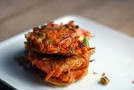
We eat potato latkas because it is a potato dish that is fried in oil, and oil is the central theme in our Chanukah story. Anything fried in oil is used such as donuts (suf-gan-iote.) These are delicious donuts with jelly in the center. Yum! Latkes are a grated potato and onion with egg and a little matzo meal to hold it together and fried like a pancake. Served golden brown with either apple sauce or-for a milk meal-with sour cream and red jam, they are scrumptious! Great party food!
5 large potatoes, peeled, 1 large onion, 4 eggs, 1/3 C matzo meal, 1 t salt, Mix and fry in 1/4 C oil.
A modern dish: Ground flaxseed and water combined to make an eggless binding agent in vegan Cauliflower-chive Latkes. from Jennie Cook.
Zucchini pancakes-used instead of potatoes.
So bring on the hoe-doo (turkey) and the latkas for November 28th, with Chanukah beginning at sundown on the 27th and Thanksgiving on the 28th and Shabbat on the 29th. We're in for a lot of feasting this year! Oh yes, don't forget to light your Chanukah candle on your menorah. We are to realize through all this fun that the world in which we live is not an end in itself, but exists to serve a higher spiritual purpose. Our candles are illuminating the darkness. We have to rid the world of ignorance, negativity, hatred and greed. We are to light the lights of knowledge, generosity, hope and love.
Resource: Oregonian newspaper 11/13/13, page L-foodday+Living, when Thanksgiving, Hanukkkah collide by David Firestone and Susan Brenna NY Times
Your Chanukah Guide from Chabad
The New Standard Jewish Encyclopedia


