Total Pageviews

Showing posts with label Rome. Show all posts

Monday, February 15, 2016

Roman Destruction of 2nd Temple and Judeans

Nadene Goldfoot                                                                                                                                           
From 37 to 100 CE, the land of Judah had been occupied by the Romans.  Romans are about to attack Jerusalem in the picture above.   "When the Romans entered, they slaughtered many Jews  from 66 to 70 CE by putting most on the cross."  As the siege of Jerusalem began in the year 70, the Passover sacrifice was beginning to which naturally many thousands of pilgrims had arrived from all parts of the country.  The number of the besieged was then very great.  Among them were many from beyond the Euphrates and other foreign lands. 


1,100,000 men perished during the siege.  97,000 were taken captive and of these, only 40,000 were saved-all being citizens of Jerusalem.  The rest were sold as slaves.  Some were sent into the mines of Egypt.  Others were distributed among the provinces for the circuses.  The 40,000 found homes nearby and others headed in the direction of Rome, to continue onto France and Germany eventually.  
In the year of 71, Titus marched thousands of Judeans he took as slaves to Rome.  The Arch of Titus commemorates the event.  He became the Roman emperor from 79 to 81 CE.  As the son of Vespasian, he had taken over command of the Roman army in Judea from his father in the year 70, when the Romans burned down the beloved 2nd Temple of the Jews.  Then he destroyed Jerusalem after a 5 month long siege.  Jewish tradition is calling Titus "wicked."  His mistress was Bernice, a Judean princess.  Perhaps because of her, he didn't accede to the demand of the people of Antioch to abolish Jewish privileges there.  
                                                                     
                                                                           
Titus, son of Vespasian, took command of the army from his father in the year 70.
"
 Battering rams made little progress, but the fighting itself eventually set the walls on fire; a Roman soldier threw a burning stick onto one of the Temple's walls. Destroying the Temple was not among Titus' goals, possibly due in large part to the massive expansions done by Herod the Great mere decades earlier. Titus had wanted to seize it and transform it into a temple dedicated to the Roman Emperor and the Roman pantheon. The fire spread quickly and was soon out of control. The Temple was captured and destroyed on 9/10th of Tisha B'Av,at the end of August, and the flames spread into the residential sections of the city.  Josephus described the scene:Everywhere was slaughter and flight. Most of the victims were peaceful citizens, weak and unarmed, butchered wherever they were caught. Round the Altar the heaps of corpses grew higher and higher, while down the Sanctuary steps poured a river of blood and the bodies of those killed at the top slithered to the bottom.
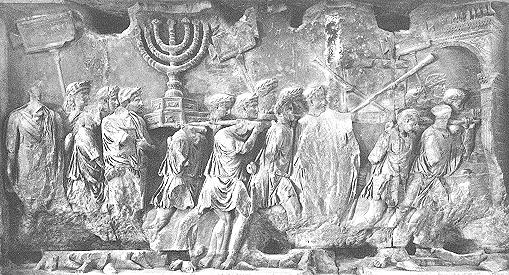
Showing  his triumph held in 71 for his successful Sack of Jerusalem.
Details easier to see in black and white.  The seven-branched menorah and trumpets are clearly depicted. It became a symbol of the Jewish diasporaIn a later era, Pope Paul IV made it the place of a yearly oath of submission. Until the modern State of Israel was founded in 1948, many Jews refused to walk under it due to a rabbinical prohibition.  The menorah depicted on the Arch served as the model for the menorah used on the emblem of the state of Israel

                                                                       
The Arch of Titus in Rome was erected by the Senate in honor of Vespasian and Titus.  The present one we can see in Rome dates from the reign of Dimitian who reigned from 81 to 96 CE.  The original structure did not survive till then.

 It shows the goddess of victory crowning Titus.  The march of Jewish captives bearing the Temple vessels, the shewbread table, 7-branched candlesticks and the trumpet; the Jordan River and the sacrificial procession is seen in the Arch.
                                                                                   
By the year 72, Vespasian, Roman emperor from 69 to 79,  took 12,,000 Jews as slaves from Judah to Rome to build the Colosseum under himself.  Nero had sent him in 67 to subdue the Judean rebellion and by 68, he had conquered the Galilee, Transjordan and the Judean coast before suspending operations after receiving the news of Nero's death.  Then in 69 he was emperor!  The campaign was ended by his son. 


Resource: https://en.wikipedia.org/wiki/Roman_triumph
https://en.wikipedia.org/wiki/Arch_of_Titus
The New Standard Jewish Encyclopedia
https://en.wikipedia.org/wiki/Siege_of_Jerusalem_(70_CE)
http://jewishbubba.blogspot.com/2014/03/lydda-israel-what-really-happened-there.html

Wednesday, May 22, 2013

Life Outside of Israel and Judea in Diaspora: Expulsions in an Intolerant World Society

Nadene Goldfoot                                                                         

                     The Life, Culture and Religion of the Byzantine Empire

 Jews faced expulsion from Rome in 139 BCE by the praetor, Hispanus.  Jews had migrated to Rome from Alexandria, Egypt.  They then made up a significant part of the population there.   This was during the Ptolemaic era.   They had then gone to Rome.  Josephus, the Jewish general who had been the historian for the Romans said that he himself had led 120,000 Jewish captives, probably from the fall of Jerusalem in 70 CE  to Egypt from Jerusalem and other parts of Judea, Samaria and Mt. Gerizim.  Soon after they were freed of their bondage  by Philadelphus.

The Roman Empire made Constantinople its capital by the 4th Century and this was called the Byzantine Empire.  This empire extended throughout the world and included "Palestine" even by the year 637.  The eastern emperors  had specific religious attitudes towards Jews.  Justinian (527-65) created anti-Jewish laws in his Code, and also issued a decree in 553 which affected the conduct of the synagogue services.  Heraclius around 614 to have issued an edict ordering the conversion of the Jews.  Judaism was continually forbidden by successive emperors; by Leo in 223, Basil I in 873-4, Romanus Lucapenus in 932-6, and so it went.  Each time Jewish life picked up and continued.  It was not about to be stomped out.

Benjamin of Tudela around 1170 found Jewish communities throughout the Byzantine Empire.  He discovered that Jews were treated with contempt in Constantinople.  The last remaining Jews there were conquered by the Turks in 1453.

The results of religious intolerance grew in the early Middle Ages.  Forced conversions to the dominant faith of Christianity without the alternative of exile was frequent during the days of the Byzantine Empire.  Jews faced expulsions when they refused to be converted to Christianity.  Today, the city of Constantinople is renamed as Istanbul.  The Eastern orthodox church grew out of it and separated from the Western Church with its headquarters in Rome in 1054.  Later it again divided into the Greek Orthodox and the Russian Orthodox with each group being independent.

  This is why the Pilgrims braved a journey in the Mayflower and sailed from Holland to the unknown land of America in 1620.  Though they were Christians, their outlook was a little different than the English viewpoint.  Thus, the USA became a country of religious tolerance; not quickly, but eventually.

We're still wondering if Christopher Columbus was Jewish by birth.  He wrote letters to his son in Hebrew.  His interpreter, Luis de Torres, a converted Jew, was the first European to set foot on American soil. His name was Yosef ben HaLevi Halvi.   Jews who were hiding the fact and pretending to be Catholics that had been converted were called Marranos.  Marranos had settled in both the Spanish and the Portuguese colonies because of the Inquisition of 1492.  The term, Marranos is not used today. Jews do not eat any meat from pigs.   It means "swine" in Spanish and was applied in Spain and Portugal to the descendants of baptized Jews who were suspected of secret adherence to Judaism.  Another word used today to replace the pejorative term of Marranos is Anussim, a Hebrew word.   Inquisitors would have people report on suspects who were thought to have evidence of them refusing to eat any pork products.  It is said that the Inquisition still exists in Portugal today!

 After the massacres in 1391 in Spain, more Jews in this position grew to appreciate their Jewish heritage.  All the Jews of Portugal for forcibly converted in 1497.  With the Inquisition in Portugal by 1540, the Marranos/Anussim were persecuted in Spain to the close of the 18th century and into Mexico into the 1800's.  Many escaped to Italy, North Africa and Turkey.  Anussim in Italy lived in Ancona, Ferrara, Venice and Leghorn.  Antwerp was another popular center in the 16th century.  Amerstadam, Holland was another as well as the Hague and Rotterdam.   When Brazil was under Dutch rule (1630-54) the first openly Jewish communities were founded by native Anussim and immigrants from Holland.

By 1880, the Jewish population in the USA had grown to 250,000 mostly from German Jews.  A small group settled in Canada then.   The pogroms of 1881 in Russia brought Russian Jews and immigration continuing into 1914, when it was lessened.  Jews went into Latin America such as Baron de Hirsch's agricultural colonies in Argentina.  1924's legislation in the USA  caused more Jews to immigrate to Canada and South America.  By 1933 those Jews in Germany were trying to immigrate to these places.  Spanish-speaking Sephardi immigrants were attracted to South America.  By 1989, Jews of the USA numbered 5,825,000.  47,000 lived in Central America and 390,000 lived in South America.

Religious intolerance continues in the USA but has taken on a new form.  By being intolerant to Israel, people  are venting their intolerance again towards Jews.  I notice many Protestant groups that are boycotting Israel's products as a religious body in trying to force them to think their way, not towards religion, necessarily but towards their attitude towards the Palestinians whom they know very little.  They side with a people trying to destroy Israel.  This is plain enough for me to see that they are not much different than the Byzantine Empire's attitude towards Jews.  On the other side of the coin are the Evangelical Christians who support Jews in order to carry forth their own religious concepts and that they support our right to live there as Jews.

139 BCE:  Jews expulsed from Rome
 19 CE        "        "                       "
 49/50        "        "                       "
115 CE     Jews expulsed from Cyprus
1182      Royal dominions of France-expulsed Jews who wouldn't convert
1290     All Jews expulsed from England
1306      Jews expulsed from France
1322       "                                "
1394      "                                "
1348/49  Jews expulsed from Germany  after Black Death Massacres
1349-60 Jews expulsed from Hungary
1421     Jews expulsed from Austria
1484     Jews  kept out of Andalusia, an autonomous community in Spain with Seville as capital
1492    Jews expulsed  from Spain and Spanish dominions including Sicily and Sardinia of 180,000
1495    Jews expulsed from Lithuania
1497    Jews expulsed from Portugal or fate was forced conversions, also Sicily and Sardinia
1498    Jews expulsed from  Navarre, now part of Spain and France
1502    All Jews expulsed from Rhodes, or forcibly converted or taken as slaves
1512   Jews expulsed from  Provence, a province of SE France
1541   Jews expulsed from kingdom of Naples, Italy
1569   Jews expulsed from smaller centers of papal dominions in Italy and France.
1727   Jews expulsed from Little Russia
1739    "                              "
1742   "                              "
1747  Jews expulsed from Russia again.
1891  Jews expulsed from Moscow and St. Petersburg
19th Century Jews expulsed periodically from areas outside of PALE OF SETTLEMENT (Russian land where Jews were allowed to live-Poland, Lithuania, Latvia, Belorussia, Ukraine)
1930's during Nazi power people with Jewish ancestry, regardless of present religious affiliations, compelled their emigration by means of ferocious persecution before they even started to deport and exterminate Jews.

For the Jewish people today, the remnant of a people who brought to the world the 10 Commandments and laws of which acts are acceptable and which aren't,  as well as a vast history of the beginnings of man in the Middle East and even brought into the world Jesus according to their own history,  there has been nothing but intolerance and unacceptedness.  Because Jews refused to convert and let go of their beliefs, they have suffered mightily.  Here they are today in their own land once again.  They know what has happened to their people when they were forced to leave.  They hold on with all their might to land legally theirs once again.

One of the miracles of today are a few Christians who are actually studying the Torah and are finding it awesome.This is not through any Jewish proselyting but they are discovering this on their own.   I believe this has brought on new found respect for the Jewish people who have always found it awesome and worth saving.  Perhaps if such an attitude existed long ago, the world would be a much different society.  At least we can say that many Jewish lives wouldn't have been uprooted or wouldn't have suffered such horrible deaths.  .

Resource:  The New Standard Jewish Encyclopedia
http://www.newadvent.org/cathen/10721a.htm on Navarre
http://sefarad.org/sefarad/sefarad.php/id/29/  "I am a Marrano"
http://en.wikipedia.org/wiki/Marrano
http://www.jackwhite.net/iberia/portugal.html   excellent
http://en.wikipedia.org/wiki/Luis_de_Torres
http://en.wikipedia.org/wiki/History_of_the_Jews_in_Egypt
http://en.wikipedia.org/wiki/Ptolemy_II_Philadelphus
http://en.wikipedia.org/wiki/Gnaeus_Cornelius_Scipio_Hispanus
Facts About Israel , divisionof Information, Ministry for foreign affairs, Jerusalem 

Tuesday, January 3, 2012

Italians of Today Could Have Jewish Ancestors

Nadene Goldfoot
Jewish settlement in Italy had started over 2,000 years ago from the Roman period to today.  Prisoners of war and slaves during the Roman-Jewish wars in Judea from 63 BCE -135 CE were brought to Rome.  In 70 CE Titus destroyed the Temple in Jerusalem and had brought many Jews as slaves along with their Menorah which the Romans had stolen from the Temple.  Jews already living in Rome paid a ransom to liberate them.  At that time there were 10 synagogues in Rome that the Jews had built.  Judah Maccabee sent ambassadors to Rome in 161 BCE and they signed a treaty with the Roman Senate.  So Jews were in Italy from before the Christian era to today.  Jews were first settled there in the 2nd century BCE in Rome and were there to greet the Jewish ambassadors.  They were there  afterwards in the southern ports and along the trade routes.  Jews were known to live there in at least 40 places before the close of the Classical Period.

Catacombs give us evidence of their way of life and the high degree of cultural assimilation.  Their lives deteriorated with the Christianization of the Roman Empire in the 4th century (300's).  They were protected by the Popes against the worst excesses and their fundamental rights were maintained.

In the Dark Ages (500-1100) , the great center of Jewish life was in the south, in Bari, etc.  These places played a great part in bringing talmudic scholarship to Northern Europe.  The southern Italian communities were mainly involved in wholesale trade, but eliminated by the Venetians later, and in handicrafts like dyeing and silkweaving. Bari was the 2nd most important economic center of mainland southern Italy after Naples.  It was a city that came under Roman rule in the 3rd century BCE.  Their port for eastward trade was mentioned in 181 BCE and was the center of the fishery business.

In Sicily, there was a large proletarian community of manual laborers.  At the end of the 13th century, persecution in the kingdom of Naples drove large numbers of Jews to Christianity.  During this period, Jewish loan-bankers began to be invited for the public convenience into the towns of central and northern Italy.  This was the origin of the famous communities of Florence, Venice, Mantua, Ferrara, etc. 

In 1492 the Spanish authorities expelled Jews from Sicily and in 1541, from the kingdom of Naples where they never again returned.  During this period Jews in other areas lived well and comfortable and were influenced by the Renaissance of 1400-1600.

The Counter-Reformation with Pope Paul IV's bull cum nimis absurdum of 1555, their life deteriorated.  This is when the Italians created the GHETTO and oppression in Rome and the Papal States with this horrible policy which was later copied all over the country.  The GHETTO PERIOD lasted until the end of the 18th century (1555-1799).  Ghettos were started in Venice where Jews were segregated in 1517.  The concept of living in a quarter where only Jews could live behind locked gates, such as the ghettos were, started from the Lateran councils of 1179 and 1215 which forbade Jews and Christians to live together in close contact.  From the 15th century, the friars in Italy began to press for the effective segregation of the Jews so that Pope Paul IV ordered that Jews in the Papal States should be forced to live in separate quarters.  This was carried into effect in Rome and became the rule throughout Italy into the next generation.  They were overcrowed but not allowed to expand and frequently had fires because of this.  This was often accompanied by forced baptism and the wearing of the Jewish badge, ssermons to convert and occupational restrictions.  It was abolished in Italy in the French Revolutionary Period of 1789-99 but reintroduced locally in the 19th century and came to an end when Rome united with the kingdom of Italy in 1870.

Most Jews were found to be living in Ancona from 1300 CE on, Livorno from 1577, Roma, Venezia and Sicily in the south. 

Emancipation came at the time of the French Revolutionary Wars of 1796-97 but was canceled on the fall of Napoleon in 1814 and was reestablished with the consolidation of united Italy in 1840-70.  In the next generations, Jewish emancipation was more complete in Italy than in any other country of Europe.  Jewish positions  on the whole was maintained in the early years of Fascism in 1922, but it 1938, after Mussolini ended an alliance with Nazi Germany, a thoroughgoing anti-Semitic policy was adopted.  Jews were removed from office and many emigrated from Italy. 

Italy did not practice the Nazi brutality, but during the German occupation of northern Italy in 1943-45, violent persecution began and some thousands of Italian Jews were deported to the death camps.  Some 3,000 Italian Jews have settled in Israel.  The Jewish population in 1990 in Italy showed 34,500, of whom 15,000 live in Rome and 10,000 in Milan.  There must be many Gentile Italians with Jewish ancestors as well. 

Reference:  The Standard Jewish Encyclopedia
http://en.wikipedia.org/wiki/Bari
http://en.wikipedia.org/wiki/History_of_the_Jews_in_Italy
http://www.italian-family-history.com/jewish/genealogy.html excellent information
I Maccabees in Bible