Total Pageviews

Showing posts with label Judah. Show all posts

Monday, February 15, 2016

Roman Destruction of 2nd Temple and Judeans

Nadene Goldfoot                                                                                                                                           
From 37 to 100 CE, the land of Judah had been occupied by the Romans.  Romans are about to attack Jerusalem in the picture above.   "When the Romans entered, they slaughtered many Jews  from 66 to 70 CE by putting most on the cross."  As the siege of Jerusalem began in the year 70, the Passover sacrifice was beginning to which naturally many thousands of pilgrims had arrived from all parts of the country.  The number of the besieged was then very great.  Among them were many from beyond the Euphrates and other foreign lands. 


1,100,000 men perished during the siege.  97,000 were taken captive and of these, only 40,000 were saved-all being citizens of Jerusalem.  The rest were sold as slaves.  Some were sent into the mines of Egypt.  Others were distributed among the provinces for the circuses.  The 40,000 found homes nearby and others headed in the direction of Rome, to continue onto France and Germany eventually.  
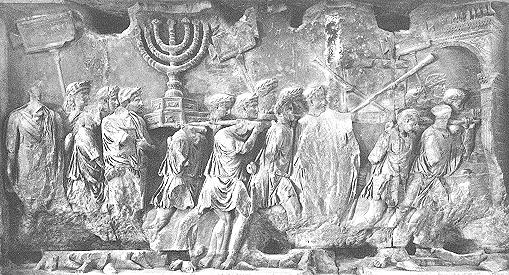
In the year of 71, Titus marched thousands of Judeans he took as slaves to Rome.  The Arch of Titus commemorates the event.  He became the Roman emperor from 79 to 81 CE.  As the son of Vespasian, he had taken over command of the Roman army in Judea from his father in the year 70, when the Romans burned down the beloved 2nd Temple of the Jews.  Then he destroyed Jerusalem after a 5 month long siege.  Jewish tradition is calling Titus "wicked."  His mistress was Bernice, a Judean princess.  Perhaps because of her, he didn't accede to the demand of the people of Antioch to abolish Jewish privileges there.  
                                                                     
                                                                           
Titus, son of Vespasian, took command of the army from his father in the year 70.
"
 Battering rams made little progress, but the fighting itself eventually set the walls on fire; a Roman soldier threw a burning stick onto one of the Temple's walls. Destroying the Temple was not among Titus' goals, possibly due in large part to the massive expansions done by Herod the Great mere decades earlier. Titus had wanted to seize it and transform it into a temple dedicated to the Roman Emperor and the Roman pantheon. The fire spread quickly and was soon out of control. The Temple was captured and destroyed on 9/10th of Tisha B'Av,at the end of August, and the flames spread into the residential sections of the city.  Josephus described the scene:Everywhere was slaughter and flight. Most of the victims were peaceful citizens, weak and unarmed, butchered wherever they were caught. Round the Altar the heaps of corpses grew higher and higher, while down the Sanctuary steps poured a river of blood and the bodies of those killed at the top slithered to the bottom.
Showing  his triumph held in 71 for his successful Sack of Jerusalem.
Details easier to see in black and white.  The seven-branched menorah and trumpets are clearly depicted. It became a symbol of the Jewish diasporaIn a later era, Pope Paul IV made it the place of a yearly oath of submission. Until the modern State of Israel was founded in 1948, many Jews refused to walk under it due to a rabbinical prohibition.  The menorah depicted on the Arch served as the model for the menorah used on the emblem of the state of Israel

                                                                       
The Arch of Titus in Rome was erected by the Senate in honor of Vespasian and Titus.  The present one we can see in Rome dates from the reign of Dimitian who reigned from 81 to 96 CE.  The original structure did not survive till then.

 It shows the goddess of victory crowning Titus.  The march of Jewish captives bearing the Temple vessels, the shewbread table, 7-branched candlesticks and the trumpet; the Jordan River and the sacrificial procession is seen in the Arch.
                                                                                   
By the year 72, Vespasian, Roman emperor from 69 to 79,  took 12,,000 Jews as slaves from Judah to Rome to build the Colosseum under himself.  Nero had sent him in 67 to subdue the Judean rebellion and by 68, he had conquered the Galilee, Transjordan and the Judean coast before suspending operations after receiving the news of Nero's death.  Then in 69 he was emperor!  The campaign was ended by his son. 


Resource: https://en.wikipedia.org/wiki/Roman_triumph
https://en.wikipedia.org/wiki/Arch_of_Titus
The New Standard Jewish Encyclopedia
https://en.wikipedia.org/wiki/Siege_of_Jerusalem_(70_CE)
http://jewishbubba.blogspot.com/2014/03/lydda-israel-what-really-happened-there.html

Monday, May 11, 2015

The Tribe of Dan and What Happened to the 10 Lost Tribes?

Nadene Goldfoot                                                                          


Samson, our strongest man,  was from the tribe of Dan.  He was one of the Israelite judges, son of Manoah. He was born before Saul of the tribe of Benjamin  became a king which was in the 11th century BCE.   He was a Nazirite from birth, meaning for one thing that he was not to cut his hair or drink any alcoholic beverage.  His hair was where he got his strength and courage and was capable of doing feats against the Philistines.  Delilah, his love, a woman of the Valley of Sorek (grapes ?) , deceived him and told the Philistines where his strength came from,  for a price.1100 pieces of silver.  She then cut his hair for them.  The Philistines held a festival in Gaza where they mocked him by having him, now a slave of theirs, to turn the prison mill for them.  He ended his life by destroying the building  and killing everyone there, including himself.
                                                                         
The movie, Samson and Delilah came out in 1949 with Victor Mature and Hedy Lamarr. This certainly immortalizes the pair.

The twelve tribes of Jacob were from 4 mothers, the sisters Leah and Rachel and their handmaids.    Dan was Jacob's 5th son and his mother was Bilhah, the handmaid of beautiful Rachel, Jacob's first love.  Reuben, Simeon, Levi, Judah, Issachar, Zebulun were the sons of Leah, daughter of Laban.   Joseph and Benjamin were the sons of Rachel.   Dan and Naphtali were the sons of Bilhah,  and Gad and Asher were the sons of Zilpah, handmaiden of Leah. Gad had developed  a warlike reputation.   This made up Jacob's  12 sons. Dinah, daughter of Leah, was the only daughter.

Moses conferred the priestly office on the tribe of Levi. This meant that Levi would not receive any land as they were to be teachers and would travel to each tribe and live there while teaching.   To maintain the number of tribes receiving territory at 12, which was a sacred number,  he divided the tribe of Joseph into the tribes of Ephraim and Manasseh, Joseph's 2 sons.  Joseph was the son who had been kidnapped and taken away to Egypt where he rose in status to have a very high commission and be working just under the Pharaoh.  He had remained in Egypt.  The Levites must have been divided up between the Empires of Israel and Judah- the North and the South.

After the conquest of Canaan, Dan was allotted a portion south of Jaffa (today joined with Tel Aviv) , but was forced back into the hill country by the Amorites, and only a part of the tribe remained in the coastal region.  The greater part of Dan was forced to migrate northward where it eventually wrested from the Phoenicians a settlement area around Laish (Judg. 8:27-9)  On the map above it is shown as the farthest north in brown.  It is also mentioned in the MAR1 tablets( or Leshem (Jos. 19:47), the name of which became Dan.  The Danites had been expelled from their original inheritance by the Amorites so moved on to the sources of the Jordan River.  "The tribe of Dan  was one to be the avenger of his people.  Dan would be the snake that bites those that would come to harm his people."

Under Joshua's division of Canaan, Reuben, Gad, and half the tribe of Manasseh received territory in what was later called Transjordan, now just Jordan.  .  Naphtali and Asher were placed on the Sidonian frontier in the Galilee.  Issachar and Zebulun were settled in the Valley of Jezereel area.  Ephraim and the other half of Manasseh were to live in the mountains of Samaria with Benjamin to their south. and Judah even further south.  So Dan was to live basically along the seacoast around Jaffa and Simeon was placed in the Negev.

The rest of the tribe of Dan's   existence grew serious after the arrival of the Philistines.  Samson was a hero of the tribe.  The period of Saul and David helped.  The northern part of Dan was the site of a temple (Judg. 18:26-30) at which the descendants of Manasseh or Moses acted as priests.  This became one of the chief cult centers in the kingdom of Ephraim, and Jeroboam erected it it the image of a calf to deflect worshippers from the sanctuary at Jerusalem.

Some other tribes also didn't succeed in occupying the entire areas assigned to them.  Simeon seized further land in Seir and the territory of the Amalekites, a tribe of Caanan especially hateful of the Israelites who treated them horribly when they came through on the Exodus.  It is said that Haman in Persia much have been from the Amalekites, and possibly Hitler was, too.

Dan was captured by Ben Hadad of Syria during the rule of Baasha around 900 BCE .They would have been the closest tribe to Syria.

This tribal division of the land was maintained under the period of the Judges, but King Solomon (961-920 BCE)  changed the format of the division of land to suit his administration.

When King Solomon died, the land of Israel split into 2 halves with the southern half going to the tribe of Judah and Simeon, sons of Jacob and Leah,  and most of the tribe of Benjamin, son from Jacob and Rachel.  So Jews of today come from these 3 tribes.  

Then, in 732 BCE, the Assyrian king Tiglath-Pileser invaded and took away people of Israel in the north  as slaves.  While the state of Judah was crippled from the loss of warriors, in 721-715 BCE the King Sargon of Assyria also attacked and took away more people as slaves.  In all, 10 tribes had been exiled from the northern kingdom of Israel.  The kidnapped population had gone mostly to Assyria, of course, but also had been sold to Media and the lands neighboring  Aram-Naharaim.

Our 10 Lost Tribes to us were mourned.  This weakened the southern kingdom of Judah who were then attacked by Nebuchadnezzar of Babylon in 586 BCE   and many were exiled.

An Israeli communal settlement at the foot of Mt Hermon near the source of the River Dan was founded by pioneers of Romanian origin in 1939.  It withstood a heavy Syrian attack in the War of Independence in 1948.  Their population in 1990 was 554.  Nearby is a tel, the site of the biblical city of Dan (Laish) which has been excavated by Avraham Biran.

 Modern Israel has a Soreq Valley and even a Sorek Vineyard (since 1994/5) producing Merlot. Soreq, however, is the grapevine itself in Genesis 49:11, Isaiah 5:2, and Jeremiah 2:21. Samson had been dedicated as a Nazirite, "from the womb to the day of his death"; thus he was forbidden to touch wine or cut his hair.

Ezekiel's prophecies (Ezek. 37:16)  about these northern lost 10 tribes has much importance as it is associated with the final Redemption with the reunion of the whole House of Israel that is to happen in the FINAL DAYS.  There has been reports in many generations of their whereabouts;

1. Eldad Ha-Dani reported them apparently in the mountains of Africa.
2. Benjamin of Tudela heard of them in Central Asia.
3. David Reuveni claimed to be the brother of one of their rulers in some region in Arabia
4. Antonio de Montezinos stimulated Manasseh ben Israel's political activity in  England by his reports that he had found them in South America
5. Shabbetai Tzevi appointed rulers over the various tribes.
6. One story associates them with the Japanese
7.  Votaries of the Anglo-Israel theory place them in the Anglo-Saxon countries. After watching a travel show into Scotland and their food  customs, I would say they had no connection to any lost tribe.  They proudly proclaimed that hunting for their food was the best thing to do and ate bloody meat.  Jews don't.  Whatever traces showing of their connection are usually in the customs, so this doesn't comply.

Actually as a historic fact, some members of the Ten Lost Tribes remained in the land of Israel and Judah,  later after 135 CE to be called Palestine.  Apart from the Samaritans, which is another case, some of their descendants long preserved their identity among the Jewish population.  Others were assimilated, while still others were presumably absorbed by the last Judean exiles who in 597-586 were deported to areas adjacent to the place of exile of the Ten Lost Tribes which was Media, Assyria and Mesopotamia.
                                                                         
Bnei Menashe In North East India, in the land mass that lies between Myanmar (formerly Burma) and Bangladesh, there lives a small group of people returning to Judaism
Today Israel is receiving reports and taking in people claiming to be of the lost tribes of Israel, who were surprised to find that others thought them lost, as they knew where they were.  The problem was that the Jews didn't know where they were and could not bring them back.  India's tribe of Menashe, called Bnei Menashe, one of the sons of Joseph, has returned to Israel.  2,000 now live in Israel.  In 2013, 7,000 more were waiting to return. Bnei Menashe are also from Burma (Myanmar) Recently a return to Judaism began. Several thousand people of Menashe decided to observe the laws of the Torah and returned to Judaism. They have synagogues in Manipur, Assam, and Mizoram. There are also those who emigrated to Israel. Thousands long for returning to Israel.

Several Christian organizations helped bring them home."In fact, the Hebrew prophets said when God gathered His Jewish people back from all the ends of the earth in the last days that there would be Gentiles helping and bringing them back," David Parsons, with the International Christian Embassy Jerusalem, told CBN News."

"India is also home to the BenĂ© Israel, a group whose Jewish bona fides are not in question. India is also home to the Bene Israel, a group whose Jewish DNA is not in question. In fact, markers in DNA samples from the Bene Israel are consistent with descendants of a small group of hereditary Israelite priests or Cohanim—those descended from Moses’ brother Aaron. They now number less than eight thousand (most of them emigrated to Israel in the 1950s), but once, more than thirty thousand Jewish People lived in and around Mumbai (formerly Bombay). "That would be the dna Cohen gene of J1.  "Some associate them with either the tribe of Zebulon or Asher because of their tradition of working as oil pressers and merchants. Others think they are Jews who fled persecution from various Arab governments.

  It is thought that the Pashtuns of Pakistan and Afghanistan could contain some of the lost tribes as they have a history of descending from Benjamin and Joseph. Some Maasais of Africa claim to be of the lost tribe.  A few have returned.  A group from Burma has as well.

The Lemba tribe of Israel has been found to carry the Cohen gene.  They even believe they have the ark of the covenant.

"Ethiopians have finally convinced Israel's rabbis that they have Jewish roots.  65,000 have moved to Israel, starting in 1974.  They say they are either from the tribe of Dan, or are descendants of King Solomon and the Queen of Sheba of Ethiopia, who had come for a visit to Jerusalem.  DNA did not turn up any evidence of a Jewish connection, but they have been practicing Judaism up to a point in our ancient history. " They should have a few of Solomon's  genes."  Today those in Israel are having a hard time adjusting, especially with rioting Blacks in the USA on TV bringing out their similar problems of education and position.    

 Anthropologist Shalva Weil of Jerusalem has documented differing tribes and peoples claiming affiliation to the Lost Tribes throughout the world.  Dr. Shalva Weil is a Senior Researcher at The Research Institute for Innovation and Education at the Hebrew University. She focuses on Indian JewryEthiopian Jewry, and the Ten Lost Tribes and specializes in qualitative methods, violence, gender, ethnicity, education, religion, and migration.  "Shalva Weil has published widely on the Bene IsraelCochin JewsBaghdadi Jews, and the Shinlung (“Bnei Menasseh”)."" Weil has published extensively on the Ten Lost Tribes and in particular, the Beta Israel, the Bene Israel, and the Pathans/Pashtuns, as well as on Judaising groups all over Africa, China and elsewhere. In 1991, she curated an exhibition at Beth Hatefutsoth: the Museum of the Jewish Diaspora on the Ten Lost Tribes entitled "Beyond the Sambatyon: the Myth of the Ten Lost Tribes".[17] She is on the international board of ISSAJ [International Society for the Study of African Jewry]"

Resource:  The New Jewish Encyclopedia p. 254,928-929
https://www.youtube.com/watch?v=-GROcMlaGTA Shalva Weil
https://www.youtube.com/watch?v=ioYAjdDALqk Jon Entine
Book:  The Lost Ark of the Covenant by Tudor Parfitt-mentioning the Lemba Tribe in Africa
http://jewishfactsfromportland.blogspot.com/2014/06/found-lost-tribe-of-israel-right-in.html
http://jewishfactsfromportland.blogspot.com/2013/10/the-assyrians-who-carried-away-10.html
http://jewishfactsfromportland.blogspot.com/2012/12/lost-tribe-of-israel-living-in-india.html
http://jewishfactsfromportland.blogspot.com/2012/11/india-burmas-lost-menashe-tribe-of.html
http://jewishfactsfromportland.blogspot.com/2012/01/can-pashtun-tribe-of-afghanistan-have.html
http://jewishfactsfromportland.blogspot.com/2012/04/10-lost-tribes-and-what-happened-to.html
http://en.wikipedia.org/wiki/Delilah
http://jewishbubba.blogspot.com/2015/01/pashtuns-and-other-lost-10-tribes-of.html
http://jewishbubba.blogspot.com/2013/09/death-bed-prophecy-for-jacobs.html
http://jewishbubba.blogspot.com/2013/03/jacobs-twelve-tribes-of-israel-and-how.html
http://jewishbubba.blogspot.com/2013/01/claiming-to-be-one-of-lost-10-tribes.html  Maasais
http://jewishbubba.blogspot.com/2012/12/why-finding-israels-lost-ten-tribes-has.html
http://jewishbubba.blogspot.com/2012/08/part-iii-lost-ten-tribes-of-israel-and.html
http://www.jewishvoice.org/messianic-education/messianic-vision/lost-tribes-of-israel.html
http://www.chabad.org/library/article_cdo/aid/1701071/jewish/Are-the-Ten-Lost-Tribes-Ever-Coming-Back.htm
http://www.cbn.com/cbnnews/insideisrael/2013/January/Lost-No-More-Bnei-Menashe-Tribe-Returns-to-Israel/
http://en.wikipedia.org/wiki/Ten_Lost_Tribes
http://moshiach.com/tribes/ns/2.html
http://www.bneimenashe.com/history.html
http://en.wikipedia.org/wiki/Shalva_Weil


Thursday, October 24, 2013

The Assyrians Who Carried Away the 10 Tribes of Israel


The Assyrians attacked Israel and took away 10 of the 12 tribes of Jacob in 721 BCE.  Who were they?  Where did they come from?  Are they the Syrians of today?   That was 2,734 years ago.

They were also a Semitic people, just like the Jews who lived in Israel.   They were from the northern area of Mesopotamia (Iraq) , which was the land between the  Tigris and Euphrates Rivers and were centered at the city-state of Ashur, which is now the Saladin Province of Iraq.  Nineveh was also one of their major cities.  It was originally one of a number of Akkadian city states in Mesopotamia.  Once it had been a great power.  .   The Assyrians tried to create their own empire. They lasted for about 15 centuries.    They were stopped by the Babylonian king, Hammurabi, who ruled from Babylon from 1728 to 1686 BCE.  So we can say that Assyria was Iraq.

The Asiatic Hurrians (Mitanni) invaded Assyria, but they were overcome by the Hittite Empire that had been growing in strength.  However, the Hittites gave up control of Ashur because it was far away from their center, so gave the Assyrians their  independence in c 1400. BCE.

The successes of King David (1010-970 BCE) and his son, King Solomon (961-920 BCE) against the Aramean states in Mesopotamia and Syria probably helped Assyria's recovery.    Damascus was taken in 806 BCE which freed Israel from Damascus' control. Damascus was the capital of Syria and still is.  It had a Jewish connection since the days of King David  in whose realm it was comprised.  It was the capital of Aram-Dammesek which was important in the days of the kings of Israel and was either a friend or a foe of Israel in different periods. A lot of Jews lived in Damascus during King Herod's reign.  He had built a theater and a gymnasium there.  When the Jews revolted against Rome starting in 67 CE, many Jews were killed in Damascus.  

By 745-727 BCE, a leader named Tiglath-Pileser III tried to renew another period of Assyrian expansion.  At least 13 states came under their domination:  Uratu, Persia, Media, Mannea, Babylonia, Arabia, Phoenicia,  Nabateaa, Chaldea, Cyprus, Moab, Edom and the Neo-Hittites.

He became king of Babylon and the Assyrian empire now stretched from the Caucasus Mountains to Arabia and from the Caspian Sea to Cyprus.  Tiglath-Pileser III had organized the Assyrian army into a first rate professional fighting force.  He also improved the administration of his empire and set the example for others that followed him.  He introduced Eastern Aramaic is their own language.

Shalmaneser V (726-723 BCE) ruled after him for a short while and consolidated their power and stopped the Egyptian attempts to get a foothold in the Middle East by defeating and driving out Pharaoh Piye from the area.  He is even mentioned in the Biblical sources as having conquered the Samaritans and being responsible for deporting the 10 Lost Tribes of Israel to Assyria. His attack on Samaria, the capital of Israel, was a siege.   He took 27,290 Israelites to Assyria and Media and replaced them with  Syrian and Babylonian prisoners.  

Sargon II (722-705 BCE) kept the empire going.  He also drove out the Cimmerians and Scythians from Iran as they had invaded and attacked the Persians and Medes, which were now vassals of Assyria.   Israel fell to them in 721 BCE.  Mannea, Cilicia Cappadocia and Commagene were also conquered.  They ravaged the Uratuwas, and Babylon, Aram, Phoenicia, Israel, and Arabia.  Cyprus and Midas (King of Phygia) were all  forced to pay tribute.

Sargon's stele (pillar)  has been found as far west as Lamaca in Cyprus (found in 1845  It was their way to brag about their accomplishments.  
 He conquered Gurgum, Milid, the Georgian state of Tabal, and all the Hittite kingdoms of the Taurus Mountains.

Egypt tried again to gain a foothold by supporting Israel's rebellion against the empire, but Sargon II crushed the uprising, and Piye was routed and driven back over the Sinai.  Sargon II was killed in 705 BCE while on a punitive raid against the Cimmerians, and Sennacherib succeeded him.

Sennacherib, king of Assyria from 705-681 BCE, Sargon's son,  was marching south and took the Phoenician cities one by one, defeated the Egyptians at Eltekeh in 701, took Ascalon and Joppa and 44 other cities and many prisoners, sacked Lachish and Jerusalem in 700 and ravaged Judah but didn't take it.  King Hezekiah of Judah was able to hold out and got some moderate terms of agreement by paying tribute and ceding some territory.  Sennacherib had to then leave as a plague hit his army.


Babylonia took  Judah finally in 597 and 586 BCE which was 100 years later.  This land is the scene of the Tower of Babel, also known as the land of Shinar or the Kasdim (Chaldees.).  Abraham was born in Ur of the Chaldeans but migrated to Canaan to live.  It was the symbol of insolent pagan tyranny.  The Babylonian Nebuchadnezzar II (604-561 BCE) inherited the Assyrian empire and took Judah in 597 BCE and again in 586 BCE.  He also exiled many Jews to Babylon,  for slavery,  most likely.   They probably came in contact with their previous Jewish tribal cousins of the captured 10 tribes.    Cyrus II (d: 529 BCE) king of Persia, had overrun the Babylonian Empire and took what had been Israel and Judah.  He  told the Jews when he conquered the land in 538 BCE  that they could return to their homes and even told them to rebuild their temple when they got there.   The Jews thought he was Divine!

What are these Semites that are Jews and Assyrians?  Our story is that Shem was one of the 3 sons of Noah, and the nations of Elam, Asshur, Arpachshad and Aram came from Shem.  Arpachshad was  father of Eber and ancestor of Abraham.  People that speak languages similar to Hebrew are called Semitic people and their languages are Semitic languages.  For example, Arabic is very similar to Hebrew.  It is called a cognate (related by descent from the same ancestral language) to Hebrew and is a branch of the Semitic languages.  There are many words that are exactly alike, and many that are almost exactly alike.  Shalom and Salaam are good examples, meaning hello, good-by and peace.  Since Ishmael and Esau were descendants of Abraham and forerunners of the Arabs, and Jews are also from Abraham and we both have Semitic languages, we say we are distant cousins.  We even share DNA that is very similar in that there is the haplogroup called the Cohen gene of J1c3d found in many Jews who are actually Cohens in the synagogue.  It's also found in some Arabs with a slight difference in it's title at the end showing it is a branch, but also labeled as J1c3d.   This should be the genes going back to Abraham and Noah.

Resource:  http://en.wikipedia.org/wiki/Assyria
http://en.wikipedia.org/wiki/Sargon_Stele

Tuesday, August 13, 2013

Jews That Never Left Israel and Judah

Nadene Goldfoot                                                                   
                                              Old Jerusalem Walls Near Tower of David
                                         
"Sephardim Jews are among the descendants of the line of Jews who chose to return and rebuild Israel after the Persian Empire conquered the Babylonian Empire About half a millennium later, the Roman Empire conquered ancient Israel for the second time, massacring most of the nation and taking the bulk of the remainder as slaves to Rome. Once the Roman Empire crumbled, descendants of these captives migrated throughout the European continent. Many settled in  Spain (Sepharadi) and Portugal,  where they thrived until the Spanish Inquisition  and Expulsion of 1492 and the Portuguese Inquisition and Expulsion shortly thereafter.  Others went onto Germany and then on up into Eastern Europe.  Because of their initial contact in Germany and France, they are called the Ashkenazim Jews.  

A misnomer is that Zionism started with Jews living in Europe (Ashkenazi Jews).  The facts are that there were Jews that have always remained in the “Holy Land,” even after 70 CE when Rome destroyed Jerusalem. They were the first to be "Zionists."   Life was not easy for them and in later centuries many came to depend on donations from abroad, but they had remained; remained, prayed and suffered through the centuries waiting for their brothers to return.  .

Those Jews living nearby in Arab countries yearned every day to return to their own land.  When World War I was over in 1918, nearly half of the total Jewish population in Jerusalem were Sephardic Jews–Jews of the Middle East which are often referred to as Mizrachi Jews. Sephardis has become the overall blanket term.

Hundreds of thousands of Jewish refugees fleeing from Arab persecution also poured into Israel who also had desired to be back in their country.  Arabs had taken over Rome’s position in a conquest of the Holy Land, but had not settled there.  They had their own well developed lands.

Before Islam came into being in 600 CE, the Sabaeans and the Nabataens,  traders with caravans,  came through into area from Arabia.  Greeks came along and pushed them out of the way in the 1st century CE. In 438 CE, the Jews from Galilee were elated when the Empress Eudocia allowed them to pray again at their holy temple site.  They thought this was the end of the exile of their people.

 The Roman Empire (70-395), who had taken Jerusalem in 70 CE were replaced by the Byzantium Empire (395-636) with Constantinople being their capital.  This was Eastern Orthodox Christianity and they spoke Greek.  Then the Sasanid Iranians, another warring empire took the front page in history.  And so it went.  Islam came into being in 600 CE.  It was in 614 CE  that Jews fought along with the Persian invaders of Palestine and overwhelmed the Byzantine garrison in Jerusalem.  They controlled the city for 5 years.  and then the Arabs conquered the land 2 decades later and  the Umayyad Dynasty followed by the Abbasid Empire.  Finally the Ottoman Empire appeared in the 1400's and they owned the property until World War I ended.

The Jews had suffered 3 centuries of Christian intolerance of which violence had been practiced spasmodically during half of that period.  This is when Jews welcomed with lots of hope in their hearts, the Arab conquerors.

Muslim Arabs (636-1072) entering 7th century Jerusalem found a strong Jewish identity.  They found that Jews lived in all parts of the country and on both sides of the Jordan.  They lived in both the towns and the villages as farmers and making many types of handicrafts.  Many lived in Lydda and Ramle-cities Arabs of today think of as Arab towns.  Other larger communities they lived in were Ascalon (Ashkelon today) , Caesarea and Gaza which was their capital when they couldn't get into Jerusalem.  Jericho was home to many Jews.  When Islam was introduced to the world, some Jews became 7th century Jewish refugees escaping from  Khaibar in Arabia.

 Khaibar had been a thriving Jewish community to the north of Mecca and Medina.  They faced death if they did not convert and had to defend their forts and mansions with their heroism as the Prophet Muhammad had "visited upon his beaten enemy inhuman atrocities," by the mass massacre of men, women and children.  What he did was completely exterminate  2 Arabian Jewish tribes.  He did this to Jews who had lived there for centuries living in freedom, peace, labor and trade and now they had been  treated as slaves and  degraded.  They had to see their wives and daughters given out among the Arab men and carried away by these conquerors.  He did this to a people who at  times of famine, would give Arabs who came to them  fruit and water and help them out.  So these Jews that survived struggled back to their Homeland.  When asked later in 1968 at an Arab theologian conference about this detestable act,  a speaker defended it by saying that Mohammad said while dying, "Never do 2 religions exist in Arabia."   He had purified Arabia from Jews.

All this time, it was a struggle for the Jews in the land to survive under these oppressive powers.  The Arabs treated Jews in the Middle East lands as dhimmis or 3rd class people who lived under a lesser quality of life due to the Arab laws.  They also prayed for their return to their homeland.  It was equally desired in both camps; Ashkenazis of Europe and Sephardis of the Middle East.  Both groups had been one in 70 CE when they parted, and both practiced the same religion and did the same things.  There are 2 great compilations of thought on the Five Books of Moses and its Jewish Law.  .  One was the was the Palestinian  or Jerusalem Talmud written before 400 CE..  About 200 years later the Babylonian Talmud  was written before 500 CE  in Iraq with about 2 1/2 million words and more than 3 times as long as the Palestinian Talmud    Each one consists of the Mishnah together with a gemara which is both a commentary on and a supplement to the Mishnah.  Both Talmuds also contain non-legal or aggadic digressions. Ashkenazis were able to study both, though the Babylonian Talmud was much better and longer.

The fact remains that we have had an unceasing strain of “Oriental” or “Palestinian” Jews in “Palestine” for millennia” who hadn’t left.  They were able to stay and hold down the fort in spite of every discouragement.  Jews had not abandoned the land physically, nor did they ever renounce their claim to to their nation.  Their claim to the land is the only continuous claim that exists.  Even though successive conquerors had devastated the Jewish organization structure they once had, the Jews never submitted to assimilation into the various victorious populations even after being devastated.  "Many Jewish scholars living in Roman-controlled Syria Palaestina moved to Persia to escape the harsh decrees against Jews enacted by the emperor Hadrian  after Bar Kokhba's revolt of 132-135.   The remaining scholars who lived in the Galilee area decided to continue their teaching activity in the learning centers that had existed since Mishnaic times".

"Jews arrived in central Europe following the crisis of the 7th century in Byzantine Palestine around the time of Muslim conquest.   Jews probably began settling along the Rhine in Germany, from  Alsace in the south to the Rhineland in the north, during the early Middle Ages."  They were then known as the Ashkenazi Jews.  It's probable that some Jews got to Germany from Rome where they were taken as slaves.  They could have even been sold to Romans going to Germany's Rhineland where the Romans had also conquered.  In their Roman period,  Jewish soldiers were found to be in Roman garrisons there, so slaves had to become soldiers.   In 321 CE, the emperor Constantine issued regulations in Cologne where Jews had settled on the Rhineland.   

It’s like studying the case of twins who have been separated at birth.  The development of Judaism in both camps appear to be exactly alike, and being they were one people originally, this is not surprising at all.  They both had the same education. They were a people separated by a situation facing exile from their homeland.  They had scattered.

The Crusaders ruled from 1099-1291 calling the land the Kingdom of Jerusalem.  Mamluks ruled from 1291 to 1516.  Jews were killed along with Arabs as the Crusaders couldn't tell the difference.  They all looked the same.  Crusaders massacred Jews throughout the Rhineland and nearby areas.  1298 saw many massacres of Jews in Germany and again in 1336 and 1348 when Jews were accused of creating the Black Death.

  In the 1400's many returned to Safed, the city I chose to live in when I made aliyah in 1980.  . Others came later  escaping the Spanish Inquisition.   Safed  was the going capital of Jewish learning and held many Yeshivahs founded by different rabbis where Jews came to study and learn.  Throughout time, Ashkenazis did try and some made it back to the Homeland and were more successful in the late 1880's with the first Aliyah.

Under Turkish rule of the Ottoman Empire (1516-1917)  the Jews in Jerusalem and in Gaza maintained cultural and spiritual unity and Sultan Suleiman I allowed many Jews to return to the Holy Land.  In 1561 Suleiman gave Tiberias, one of the Jewish 4 holy cities, to a "secret Jew," from Portugal, Don Joseph Nasi, who rebuilt the city and the villages around it.  this attracted Jewish people to come and live there from any areas of the Mediterranean.

The post-Roman Christians had turned around and caused physical violence on Jews and pagans alike.  Despite their cruelty, more then 40 Jewish communities survived and could be traced in the 6th century.  They were 12 towns on the coast, in the Negev, and east of the Jordan which was land that was part of the Palestine mandate that Britain held in 1922.  This land had been dubbed "Transjordan then and was declared the Hashemite Kingdom of Jordan.  He had just taken it and seemed to get away with it.  The Jews were also living in 31 villages in the Galilee and in the Jordan Valley at that time.

On May 14, 1948, we had 650,000 Jews living in Israel and 126,000 Arabs.   Today we have 6 million Jews, the same number we lost in the Holocaust.  In the 24 years since this date, entire Jewish communities from Arab countries have made aliyah to Israel.  Out of Iraq came 121,000 out of the 130,000.  Out of Yemen came 44,000 of their 45,000.  Out of Libya came 30,500 out of their 35,000.    Moroccan, Tunisian, Poland and other countries   had 165,000 Jews return between 1955-1957.  It wasn't until 1994 that the last Syrian Jews were able to get to Israel being they were held like prisoners.  

Resource:From Time Immemorial by Joan Peters
 The New Standard Jewish Encyclopedia
Text: Middle East Past and Present by Yahya Armajani and Thomas M. Ricks
http://www.jewishvirtuallibrary.org/jsource/Judaism/mejews.html
http://en.wikipedia.org/wiki/Jerusalem_Talmud
http://en.wikipedia.org/wiki/Ashkenazi_Jews

Thursday, July 18, 2013

The Revolt Against Syrians By Jews; the Hasmoneans

Nadene Goldfoot                                                                         

Israel was divided in half in 933 BCE when King Solomon died.  The southerly of the 2 kingdoms was Judah and the northerly kingdom remained as Israel.  The last king of Judah was Zedekiah who ruled from 597 to 586 BCE.  This is when the Babylonians attacked and large numbers of the inhabitants were deported.  An attempt to perpetuate a subject state was made under Gedaliah, a member of the former royal house, who became governor of Judah by being appointed by the Babylonians after the destruction of the 1st Temple in 586 BCE.   His rule ended with his assassination  in 582 BCE by the commander Ishmael ben Nethaniah and his followers who were planning a revolt against Babylon.  Gedaliah's supporters then had to flee to Egypt for safety.  .

The descendants of the exiled Jews living in Babylon continued to love their national and religious ideals. Their condition improved when the ex-king Jehoiachin was let out of prison and was given the royal honors in 561 BCE.   After 538 BCE the exiled were able to renew Jewish life and return to the area of the former kingdom of Judah because Cyrus of Persia permitted them to return to Judea if they wanted.  He had just overthrown Belshazzar of Babylonia.   They had been kept away for about 70 years.     The canonical prophets carried on their activity and great parts of the Bible were composed and the essential traditions of Judaism were developed and preserved during  this period.

The Hasmoneans were a priestly family and dynasty founded by Mattathias of Modiin in Israel.  The priestly line was started by Aaron, brother of Moses.  They were probably called Hashmonai (Hasmonean) after his ancestor, Hashmon, but  the name could have come from a place-name found in Josh.5:27.
                                                                       
Mattathias was a patriot, a priest and a landowner of Modiin. He had 5 sons; Judah the Maccabee, Jonathan, Simon, John, and Eleazar. Mattathias killed the royal official who was sent to make the Jews worship Zeus.  This was the focus of the revolt of his sons against Antiochus Epiphanes.  Mattathias was the leader of the revolt and was staying in the Judean hills and waged a guerilla war on the Syrians.  He was killed and his son, Judah the Maccabee, took over.  He was later called the Hammerer because he hammered away at the Syrians.  We remember Judah and his brothers being victorious over Antiochus Epiphanes and their rededication of the Temple that the Greeks had taken over.  They had placed statutes of their gods in the Temple which was for the one and only unseen G-d of Abraham, Isaac and Jacob and all the people that believed in one G-d who came to be known as the Jews.  We remember these brave brothers during Hanukkah, which always happens in close proximity to Christmas.

Antiochus was the name of 13 Greek kings of the House of Seleucus who ruled Syria in the Hellenistic Period.  Antiochus III reigned from 223 to 187 BCE.  He transferred 2,000 Jewish families from Babylon to Lydia and Phrygia.  He captured Jerusalem in 198 BCE and treated the Jews with understanding.  Antiochus IV Epiphanes followed him and reigned from 175 to 163 BCE.  He fought against Egypt in 168 BCE but was turned back by Rome in his 2nd expedition.  He occupied Jerusalem, plundered the Temple treasure and tried to Hellenize Judea by force in order to convert it into a frontier-province that was reliable.
                                                                       
The Hasmoneans were rebelling against the hellenizing policy by the Syrian king Antiochus Epiphanes.  It was from 166 to 164 BCE that the Hasmoneans fought a number of successful battles against the Syrians which caused the Syrians to fight back against them with great cruelty.  Thousands of Jews were killed and many were sold into slavery.  Antiochus E.  brought in gentile settlers into Jerusalem and fortified the Acra as a stronghold of the Hellenizers to rule the city.  Then he began a religious persecution of the Jews, and forbid circumcision and the observance of the Sabbath.  He desecrated the Temple altar and set up pagan altars in other towns and compelled the Jews to take part in pagan ceremonies.  This caused the Hasmonean uprising.  His son, Antiochus V reigned from 164 to 162 BCE and continued the war against the Jews until 163 BCE when he granted them religious and some political autonomy in return for their acceptance of his rule.  In 164 BCE, however, Judah had captured Jerusalem back and rededicated the Temple.

This was followed by a series of raids to rescue the Jewish populations of Ammon, Idumea, Gilead and the Galilee They were defeated in 163 at Bet Zechariah where Eleazar was killed.  The Hashmoneans were able to obtain terms securing Jewish religious freedom, but Judah and his party, aspiring for political freedom also, continued the fight and Judah fell at Elasa in 160 BCE.  John was murdered shortly afterwards and Jonathan took over the leadership.  He was able to secure the high priesthood and governorship of Judah in 150 BCE.  Simon succeeded in gaining exemption from tribute by 147 BCE and was confirmed by the people as hereditary high priest, ethnarch and general in 142, but was murdered in 135 BCE.

His son, John Hyrcanus, who succeeded him, suffered a crushing defeat by Antiochus VII Sidetes.  Jerusalem was taken by the Syrians after a prolonged siege and Judea once more became a Seleucid province.  After the defeat of Antiochus in his war against Parthia, John launched a successful offensive against Transjordan, Samaria and Idumea, which marked the change of the Hasmoneans to a semi-Hellenized secular military dynasty.  This led to his adherence to the aristocratic Sadducee party.  He was succeeded by his sons Judah Aristobulus (105-4) and Alexander Yannai (104-76), one of whom was the first to adopt the royal title.  .

Josephus (Flavio Josefo) told of an argument recorded in 63 BCE between the father, John Hyrcanus and his son, Judah Aristobulus, about winning the favor of Pompey and get the scepter of his people.

Pompey (106-48 BCE) was a Roman general who arrived in Syria in 65-3 BCE and became the arbiter in a dispute between Hyrcanus II and Aristobulus I (104-103 BCE)  for the throne of Judea. Aristobulus  was the eldest son of John Hyrcanus and was to have been high priest with the administration of the state of Judah being left in his mother's hands.  However, he murdered his mother and his brother, Antigonus and imprisoned his other brothers.  He then extended the northern boundaries of Judea.  He was an admirer of Greek culture and called himself Philhellene.

Ultimately Pompey favored Hyrcanus II.  He captured Jerusalem and the Temple from Aristobulus' supporters.  He left the shrine intact, although he entered the Holy of Holies.  The state of Judea was made a tributary and stripped of the territories acquired by the Hasmoneans.  Aristobulus and his family were taken to Rome to grace Pompeys triumph.  Pompey terminated Jewish independence that had been enjoyed since Simon the Maccabee.

 Either the father or his son had accused the other of encouraging piracy.  There is evidence of Jews who fought pirates in the 1st century before the common era, or 100 BCE.  This was written about by Jose Chocron Cohen in an article written for the Center for Sephardic Studies in Caracas. Flavio Josefo told about Hebrew sailors in Roman ships that fought against attacks from the port of Jaffa.

The 2nd son of John Hyrcanaus, Alexander Yannai (104-76),  set up a standing mercenary army and conquered Transjordan, Idumea and the coastal plain.  He was against the Pharisees who opposed his war policy, and this led to a civil war in which he was the winner.  Yannai's widow was Salome Alexandra (76-69).  With her death, the Hasmoneans declined.  Her sons, Hyrcanus II and Aristobulus II had a lot of strife which led to the intervention and eventual domination of Antipater and his son Herod, with Roman assistance.

Pompey reduced the country's territory in 63. He had seized the Temple in Jerusalem.  This is when, after a civil war, the 2 brothers appeared in Damascus to urge their claims before Pompey  Hyrcanus became king after his mother's death,  but Aristobulus II had usurped the throne.  He remained a puppet, while the efforts of Aristobulus II and his sons, Alexander and Antigonus Mattathias  tried to regain power but failed to do so.However,   Aristobulus II the younger son,  reigned from 67-63 BCE as King of Judea.

When Julius Caesar rose to power, Aristobulus II was released from prison in 49 and was promised 2 legions with which to attack Pompey's supporters in Syria.  He was poisoned before he was able to start.

 Aristobulus II had a son, Antigonus (Mattathias) who was the last Hasmonean king and ruled from 40 to 37 BCE.  With the support of the Pathians, he captured Jerusalem in 40 and put Herod's brother, Phasael, to death and mutilated his own uncle Hyrcanus so as to disqualify him for the high priesthood.  Then he was high priest and King of Judea.  The Romans then drove the Parthians from Syria in 39 and Herod attacked Antigonus who was defeated in battle.  He fortified himself in Jerusalem, but was captured after a 5 months siege and put to death.
                                                                         
 Hyrcanus's granddaughter, Mariamne,  had married Herod but was put to death by him in 29.  So were the surviving Hasmoneans; Aristobulus II in 35, Hyrcanus II in 30, and Mariamne's sons, Alexander and Aristobulus in 7.  Mariamne's brother was Aristobulus III. and was the last Hasmonean high priest.  He was the grandson of Aristobulus II.  Herod was suspicious of him but feared Mark Antony, so he appointed Arisobulus III as the high priest at the age of 17.  The people showed that they accepted and liked him very much when he appeared in his robes on the Feat of Tabernacles and this made Herod jealous.  He had him killed by drowning in a swimming pool in Jericho.

Resource:  The New Standard Jewish Encyclopedia
Jose Chocron Cohen's article for Center for Sephardic Studies in Caracas
Josephus 

Wednesday, February 27, 2013

The Jewish Homeland: From 1st to 20th Century-Ruled By Foreigners But Not By the People

Nadene Goldfoot
1,878 years went by from 70 CE to 1948, the land of Israel and Judah was ruled by foreign governments from afar.  People who lived there had no say.  The names were also changed.  

70-395 CE:  Romans Rule:  from Rome:   Tried to obliterate Jewish identity of the Land.  Changed the name to Palaestina and Jerusalem to Aelia Capitolina.  Spoke Latin.

395-636 Byzantine Rule:  from Constantinople, head of Eastern Orthodox Christianity, spoke Greek. Emperor Justinian

636-1072 Arab Rule: from Saudi Arabia; Mecca, Medina,  The Land was divided by the Arabs into 2 military districts on both sides of the River Jordan, Filastin (Palestine), and urdun (Jordan).  Arabs only built the  town of Ramla  which became an administrative center.  Spoke Arabic

1072-1099 Seljuk Rule- Turks possibly from Khazaria , Spoke Turkish, many languages

1099-1291 Crusaders' Rule:  kings from Christian Europe,   The Land was named "the Kingdom of Jerusalem".  spoke English, French,

1291-1516  Mamluk Rule:  Egyptian slaves of Turkish and Mongol descent, drove out Crusaders The Land was divided into 3 districts; Mamlaka:  Safad, Gaza and Damascus.  There was no name for the Jewish Homeland. spoke Turkish, Mongolian, a little Arabic

1516-1917:  Ottoman Rule: from Turkey,  The Land was divided into separately administered districts of Sanjaks, Vilayets.  There was no name for the Land as a whole.  Sided with Germany in WWI, lost.  spoke Turkish

1918-1948:  British Rule:  Held the mandate from the League of Nations.  Renamed the land "Palestine."  Mandate extended on both sides of the Jordan.  In 1922 Britain partitioned territory into Palestine on West side and Transjordan on East side of Jordan River.  Transjordan later became Jordan.

May 14, 1948 Israel was pronounced a state among the other nations through the UN. Speaking Hebrew.

Resource:  Facts about Israel 1973 edition, page 26, 27.
Text:  Middle East Past & Present by Yahya Armajani and Thomas M. Ricks; Portland State U.
http://en.wikipedia.org/wiki/Seljuk


Sunday, February 24, 2013

Jews: What Happened to Them After King Saul of Israel

Nadene Goldfoot
Saul,  of the Tribe of Benjamin,  was chosen  to be the first  king of Israel (about 1020-1004 BCE..  David, from the tribe of Judah,  was the next king and founded a dynasty of  4 hundred years until the Babylonian conquest.  He had created a kingdom and made Jerusalem its capital (abt 1,000 BCE).  Solomon, his son,  (965-928 BCE) caused the kingdom to become an important power in the Middle East.  He built the First Temple (960 BCE).  During his reign Hazor, Megiddo and Gezer were founded.

Solomon died and the kingdom split into two:  Judah with the capital in Jerusalem under King David's descendants and Israel which continued with the original name and its half with a new capital in Samaria, ruled by a series of dynasties. Their first king was Jeroboam, from the tribe of Ephraim (933-912 BCE).

Israel came to an end in 722 BCE when Assyria conquered it and part of the population was exiled.  Sargon II was the conqueror who resettled it with Cutheans (idolaters, possibly of Assyrian people)  who intermingled with the remnants of the Israelites.  They had converted but retained their idol worship and finally Jews were not allowed to marry them.  The capital, Samaria, became a center in the Persian period and became a Macedonian colony in 331 BCE.  It became a village in the Arab period.

The Samaritans are probably the descendants of the remnant of Ephraim or Manasseh tribes and the non-Israelite colonists brought in and live today as a small ethnic group and separate religious sect in Nablus and in Israel. Their religion is a primitive form of Judaism but their bible is only the Pentateuch with variations.  To them, the sanctuary is Mt. Gerizim.

Judah was conquered in 586 BCE by the Babylonians who destroyed the First Temple.  A large part of the population was exiled to Babylon (Iraq today) and others fled to Egypt.  Large Jewish communities had existed since that time in both Israel and Judah until before 1917 when they dwindled.
The prophets existed during this 500 year period.  Their message basically was the struggle for social justice.
_______________________________________________________________________________
The Babylonian Empire was finally overthrown by the Persians (Iran) so the land of Israel was also under Persian rule.  King Cyrus of Persia allowed the Jews to return to the Land and rebuild the Temple (538 BCE).  Jews then lived in their land autonomously for 400 years under the Persians.

After 332 BCE Jews were under Hellanistic rule.  In 168 BCE the Hellenistic ruler of Syria, Antiochus Epiphanes IV tried to limit Jewish autonomy and replace monotheistic belief with idolatry.  The Jews revolted under the leadership of a Hasmonaean family and regained their independence.  It's thought that the Hasmonaeans were of the tribe of Levi.  They ruled Judah.  Herodian then ruled after that.

By 63 BCE the kingdom was part of the Roman Empire.  Herod  ruled and he was responsible for the reconstruction of the Temple. Herod was the son of Antipater the Idumean  and his wife, a Nabatean named Cypros.  He had been appointed by his father to be the governor of Galilee.  He was appointed king of Judea by the Roman senate and had captured Jerusalem in 37 CE with the help of the Romans.  Idumean or Edom was a country in SE Eretz Israel, also called Mount Seir.  It lay south of the Dead Sea and bordered the Red Sea at Elat.  The people were of Semitic origin, descendants of Esau and lived by  hunting.  They were traditional enemies of Israelites.  They fought Saul but were defeated by David.  They were conquered by John Hyreanus who forcibly converted them to Judaism, and then they became a part of the Jewish people.  Herod was one of their descendants.  John Hyreanus was the son of Simon the Hasmonean (135-104 BCE)  who beat Ptolemy in taking Jerusalem.

Jerusalem became an important metropolis with about 200,000 people.  Herod died in 4 BCE.  Romans tightened their rule.  In 66 CE Jews revolted against the Romans until 70 CE when the Romans destroyed Jerusalem and the 2nd Temple.  In 73 CE, Masada, the last Jewish fortress was taken by the Romans.   At this time the Jewish population was about 3 million.

Bar Kokhba was a leader who revolted against the Roman Empire and died in 135 CE in the revolt against Hadrian.  He was a descendant of King David.  Letters written by him were discovered near the Dead Sea.  The Romans had been rebuilding Jerusalem as a Roman colony and they were prohibiting circumcision.  There were 580,000 Jewish casualties in this revolt.  Many others died of hunger and disease.  Judah fell into desolation.  Jerusalem was then barred to Jews.  The revolt lasted over 3 years involving the best of the Roman forces.

Then many Jews were driven into exile and large Jewish communities emerged in other Middle East countries and beyond. They wandered as far as Saudi Arabia where whole Jewish tribes were forced to convert to Islam or be killed.  Jewish communities were founded all over the Middle East.and came to be known as the Sephardi Jews as contrasted by the Ashkenazi Jews who wandered farther into Europe.

 Jews had originally entered the land of Canaan with Moses (1391-1271 BCE) and consisted of the children of the 12 sons of Jacob, his 2 wives who were sisters (Leah and Rachel) and their 2 handmaids (Zilpah and Bilhah)  who had founded their own tribes.  Reuben, Simeon, Levi, Judah, Issachar, Zebulun, Joseph, Benjamin, Gad, Asher, Dan and Naphtali.  Judah was always the largest of the tribes.  Jews think of themselves as being either Cohens, Levites or Israelites.  Today with the development of DNA studies, the Cohen gene (haplogroup J1)  has been found. The interesting factor is that most of these people are also functioning as the Cohen in their synagogue, showing why this is called the Cohen gene.  This is an inherited position in the synagogue that comes with certain responsibilities, namely being called as the first reader from the Torah on Saturday (Shabbat).  It shows that oral history has passed down correctly for 2,000 years.  Another J1 line is the J1c3d which is is thought to come from Arabs and originating from Esau, Isaac's half brother.  This branch does not reflect many Jews but is a Semitic line.

We must remember that Abraham and his father, Terah, left Ur (Iraq) to establish a monotheistic religion. If Abraham and his father were J1....they left ancestors and relatives in Ur who also went on to establish more individuals who would have spread J1...  Abraham, Isaac and Jacob were the 3 who would have continued the Jewish or Cohen J1  Y haplogroup.  Branches of families have been found, such as the Cohen J1c, J2a1b, J2a4 and the other Semitic J1 such as J1c3d who today are Muslims. Also, Jews have been scattered all over the earth, especially in the Middle East.  No wonder we are finding similar Ydna among Jewish and non-Jews.

Resource:  http://en.wikipedia.org/wiki/Tribe_of_Benjamin.
Facts About Israel from division of information ministry for foreign affairs, Jerusalem
The New Standard Jewish Encyclopedia
http://en.wikipedia.org/wiki/Jeroboam
http://www.myjewishlearning.com/texts/Bible/Origins_of_the_Bible/Other_Ancient_Texts/Books_of_Maccabees/First_Maccabees.shtml
http://www.schechter.edu/AskTheRabbi.aspx?ID=477 Cutheans
http://en.wikipedia.org/wiki/User:Victar/Haplogroup_J1c3d_(Y-DNA)
http://en.wikipedia.org/wiki/Talk%3AHaplogroup_J1c3d_(Y-DNA)
http://kahana.hubpages.com/hub/More-on-the-Kohanim-DNA-Question