Total Pageviews

Showing posts with label Romans. Show all posts

Saturday, May 14, 2016

RASHI's Troyes, France, and His Family's 1st Run-In With Crusaders

Nadene Goldfoot                                                                        

RASHI,  the acronym and the name Rabbi Solomon Yitzhaki (ben Isaac) was called, was born in Troyes, France in 1040-976 years ago.  How had Jews come to France from Jerusalem when the Temple fell in 70 from Rome's takeover?  They probably followed the Roman-made highway to another Roman center along Via Agrippa to Troyes.  RASHI also died here in 1105.  No doubt, Jews had been trading with Troyes before the fall of the Temple in the year, 70, so some Jews were familiar with it.
                                                                       
1st Crusaders 
  It was here that RASHI made his livelihood with his vineyard.  He had studied in the Rhineland next door, mainly in Worms. "He was a fantastic scholar and studied with the greatest student of Rabbenu Gershom of Mainz."  When he returned to Troyes, he established his own school, which achieved a wide reputation.  He was a writer of commentary on the Bible, mainly the Torah (Pentateuch) ,  and the Babylonian Talmud.  He survived massacres of Jews from the First Crusaders of Europe.
                                                                     
"Troyes (French pronunciation: ​[tʁwa]) is a commune and the capital of the department of Aube in north-central France. It is located on the Seine river about 150 km (93 mi) southeast of Paris. This area is known as the Champagne region of Northern France. . Troyes has been in existence since the Roman era, as Augustobona Tricassium, which stood at the hub of numerous highways, primarily the Via Agrippa.  "Before Julius Caesar’s conquest, Troyes was already a town of the Gauls; under the Roman emperor Augustus it became the capital of the Gallic tribe known as the Tricasses (hence its name)."  

"The city was converted to Christianity in the 3rd century, and then the town was threatened by the Huns in the 5th century and was defended against them by its bishop, St. Loup. 

Sacked by the Normans in 889, it soon came under the authority of the counts of Champagne, who founded a number of churches and almshouses there and established the great fairs which gained an international reputation and brought Troyes exceptional prosperity"
In the early cathedral on the present site, Louis the Stammerer in 878 received at Troyes the imperial crown from the hands of Pope John VIII.   At the end of the ninth century, following depredations to the city by Normans, the counts of Champagne chose Troyes as their capital; it remained the capital of the Province of Champagne until the Revolution.. During theMiddle Ages, it was an important trading town, and gave its name to troy weight. The Champagne cloth fairs and the revival of long-distance trade and new extension of coinage and credit were the real engines that drove the medieval economy of Troyes.
In 1285, when Philip the Fair united Champagne to the royal domain, the town kept a number of its traditional privileges. John the Fearless, Duke of Burgundy and ally of the English, aimed in 1417 at making Troyes the capital of France, and he came to an understanding with Isabeau of Bavaria, wife of Charles VI of France, that a court, council, and parlementwith comptroller's offices should be established at Troyes. It was at Troyes, then in the hands of the Burgundians, that on 21 May 1420, theTreaty of Troyes was signed by which Henry V of England was betrothed to Catherine, daughter of Charles VI, and by terms of which he was to succeed Charles, to the detriment of the Dauphin. The high-water mark of Plantagenet hegemony in France was reversed when the Dauphin, afterwards Charles VII, and Joan of Arc recovered the town of Troyes in 1429."
I notice that Wikipedia has not mentioned RASHI at all under Troyes, even though they list famous people born there, and he is the most famous and earliest of Jewish commentators of the Bible.  
                                                                      
2nd Crusaders of 1147 who almost killed RASHI's Grandson, a Tosaphist.
The Second Battle of Dorylaeum took place on October 25, 1147. Conrad III stopped in Dorylaeum with his 20,000 Germanic troops, to rest, but was badly defeated by the Seljuk Turks led by Mesud I. Unable to continue the Crusade, Conrad journeyed to Louis VII of France's army only to have the Crusade fail completely
Tosaphists were French and German scholars of the 12 to 14th century who criticized and modified with explanatory notes on the Talmud.  "The most famous of these Tosafists was Rashi's grandson, Rabbenu Tam (Jacob Ben Meir Tam-our perfect Master (1100-1171) , who frequently disagreed with his grandfather.  He was the brother of Samuel ben Meir (Rashbam) and lived at Ramerupt until his home was destroyed by Crusaders in 1147 and he himself narrowly escaped death.  " On May 8, 1147, on the second day of the Feast of Weeks, French crusaders broke into his home, robbed him of everything except his books, dragged him into a field, insulted him on account of his religion, and decided to kill him. They inflicted five wounds upon his head, in order, as they said, to take revenge upon the most prominent man in Israel for the five blows which the Jews had dealt to Jesus. At that moment a prince of high rank happened to pass, and Jacob called upon him for protection, promising him a horse worth five marks in return. The prince thereupon bade the crusaders give the rabbi into his keeping, promising that he would either persuade him to be baptized or place him in their power again on the following day (Ephraim bar Jacob, in Neubauer and Stern, "Hebr. Berichte über die Judenverfolgungen Während der Kreuzzüge," p. 64)".Then he also settled in Troyes where in 1160, the first conference of French rabbis met under his leadership.  He had become the outstanding rabbinical authority of his day.  To this day, some orthodox Jews alternately wear 2 pairs of tephillin, one according to Rashi and the other according to Rabenu Tam.  
                                                                               
And when the Philistine looked and saw David, he disdained him, for he was but a youth, ruddy and handsome in appearance." In 2015 a 10-year-old Russian volunteer at Jerusalem’s Temple Mount Sifting Project found a seal from the time of King David in the 10th century BCE
Our family is related to RASHI as we have found out through DNA testing with an autosomal test, and we are not alone.  Many others are, too.  Rashi's family tree traced back to a connection to King David of Israel (1010 BCE-970 BCE).  .  

Resource; The New Standard Jewish Encyclopedia: RASHI
https://en.wikipedia.org/wiki/Troyes
https://www.jewishvirtuallibrary.org/jsource/biography/rashi.html
http://www.britannica.com/place/Champagne-region-France
http://www.jewishencyclopedia.com/articles/8436-jacob-ben-meir-tam
https://en.wikipedia.org/wiki/David

Wednesday, April 2, 2014

Pharisees and Sadducees of 2nd Temple and Christianity

Nadene Goldfoot                                                                    

                                                  King  Solomon's Temple

Moses (1391-1271 BCE) didn't just bring down 10 Commandments.  Throughout the 40 years of wandering during the Exodus, started when he was 80 years old already,   he wrote 613 more laws for the future Jews to follow till he died at age 120.  What do we Jews believe, anyway?  The ideas we have of course came from Moses, but they were also interpreted by the Pharisees and the Sadducees.

Two traumatic events happened to the Jewish people.  The Assyrians attacked and carried away people in 721 BCE.  The Babylonians attacked twice; in 597 and 586 BCE.  They also carried away people.  They destroyed Solomon's Temple.

The Jews rebuilt the Temple.  During the 2nd Temple period from 538 to 515 BCE, there appeared a political party as well as a religious one, the Pharisees (the lenient ones) , who were probably a continuation of the Hasideans, a pious Jewish religous sect.  It was first recorded during the persecutions of Antiochus Epiphanes in the 2nd century BCE when its member suffered martyrdom rather than desecrate the Sabbath and formed the backbone of the Hasmonean revolt.  .  They were a fairly narrow body and kept a closed membership to the masses.  Their job was to teach the traditions to everyone with stories to develop a holy spirit in them.  They felt there was a huge gap of knowledge between the masses regarding  their own law and themselves and therefore the masses were not practicing it.

They sat apart from the masses in order to keep themselves pure.  In other words, they were scrupulous about keeping kosher.  They would eat with their own groups and ate only consecrated food in the Temple, or kosher food that had been prepared in the Temple kitchen.

The Pharisees put the people of Judah's life within a halakhic framework found in the Oral Law which they regarded as vital as the Written Law (the Tanakh). The oral law was the interpretations and analysis of the written law and was handed down orally from generation to generation.  It's said it also was given to Moses with the written law.   Their doctrine was to embrace the whole life of the community, touching on the theological foundations of life, questions of fate, good and evil, the immortality of the soul, and eschatology.

They admitted Divine predestination but also man's responsibility for his deeds.  They believed in life after death, the resurrection of the dead, the Messiah that they needed and the Day of Judgment.

Not all Pharisees were angels in their behavior, of course.  The Talmud lists 7 hypocritical types.  However, they "were in reality not like the derogatory New Testament picture" that paints them as terrible people.  It just so happens that "they were responsible for strengthening morality and introducing the elasticity which enabled Judaism to withstand its subsequent tribulations."

The Pharissees had the chutzpa to bring into their culture the cult-folk-customs not mentioned in the Torah, such as the Water-Drawing Festival (Simchat bet ha Shoevah), which dismayed the Sadducees.  This was a festival of water-libation observed at the end of the first day of the Feast of Tabernacles.  The Sadducees didn't want it included in their observances because it had no authority in the Pentateuch, but the people nevertheless observed it enthusiastically.  The ceremonies are elaborately described in the Mishnah under (Sukkah 5).  It fell into abeyance with the destruction of the Temple but has been revived in an altered form in modern Israel.  I can understand that any holiday involving water emergence or enjoyment would be loved in the hot land of Judah.The Pharisees have been carried into the stream of historic Judaism.

Bill O'Reilly of Fox News on TV  has written a book that carries out the derogatory essence of the New Testament. Yes, the Gospels may be sacred to Christians, but they hold a lot of anti-Semitism towards the Jews.  O'Reilly's book is "Killing Jesus," the act that the Christians have been blaming Jews for during  the past 2,000 years.  It has only been recently that Pope Benedict XVI finally forgave us, but that was the pope himself.  The masses haven't all agreed with him as yet.  The pope also wrote a book, Jesus of Nazareth."  "In 'Jesus of Nazareth' excerpts released in 2011, Benedict uses a biblical and theological analysis to explain why it is not true that the Jewish people as a whole were responsible for Jesus' death.  Perhaps he still believed that some Pharisees were still responsible.  I'm not sure.  We've been suffering for this as a people  from the Crusades to the Inquisition in Spain.  All Jews have suffered from anti-Semitism and this is what has got the masses going, the death of Jesus.  From there they have managed to find all sorts of reasons why they hate Jews.  We've become the scapegoats of the world.  

Interpretations to the contrary have been used for centuries to justify the persecution of Jews. " While the Vatican has for five decades taught that Jews weren't collectively responsible, Jewish scholars said recently that  the argument laid out by the German-born pontiff, who has had his share of mishaps with Jews, was significant and would help fight anti-Semitism today.  Of course O'Reilly's  main references must rely on the four Gospels which are loaded with attacking Jews.  Jesus had died on the cross, and that was something the Romans had been doing to thousands of Jewish men for any slight indiscretion to their own Roman government.  But the Christians forming a group after his death blamed the Pharisees and Sadducees for it to have happened.   This happened during Herod's time of ruling, a man who was appointed ruler over the Judeans by the Romans.

It was Pontiius Pilate who ruled in the case of Jesus.  He was a procurator, a governor of Judea under the Roman emperors and ruled from 26 to 36 CE.  As a procurator, he had full powers to inflict punishment including the death penalty, which meant to be placed on the cross.  He executed  with the cross Galilean patriots (Jewish men) without a trial and introduced Roman military standards into Jerusalem, used Temple funds for the construction of an aqueduct and maltreated the Samaritans for which he was finally recalled to Rome.  Jesus was crucified during his term of office along with thousands of other Jews.

The problem lies with the Gospels referring often to the Sadducees and Pharisees because Jesus was in constant conflict with them.  They were the ruling group of Israel in religion.  The Christians in the Gospel claim that the two groups conspired to put Jesus to death, as told in (John 11;48-50;  where it mentions that many Jews were believing in Jesus, the Romans were going to take their nation, and Caiaphas, a high priest (18-36 CE) that year said that one man should die for the people and that the whole nation would perish otherwise so he prophesied that Jesus should die for that nation. Joseph Caiaphas  was appointed as high priest by the procurator, Valerius Gratus and also served under Pontius Pilate.  The New Testament represent him and his father-in-law Annas as being responsible for the prosecution of Jesus and the arrest of the apostles.  He was removed by the Syrian governor, Vitellius.  Then they (other priests ?) took counsel together to put Jesus  to death.  After that Jesus didn't walk up to the Jews anymore but went into the countryside  near the wilderness into Ephraim with his disciples.   Mark in 14:53; and 15:1), also presented anti-Semitic words  Other mentions of the Sadducees are found in Act 4:1 and Acts 5:17.  The Sadducees are implicated in the death of James by writer Josephus (Acts 12:1-2).  He was writing for a Roman audience.

The Catholics teach in their Catechism for the Catholic church that from the beginning of Jesus' public ministry, that certain Pharisees and partisans of Herod, together with priests and scribes had agreed to destroy Jesus.  The reason was that they suspected Jesus of demonic possession and accused him of blasphemy and false prophecy which were religious crimes which the Law punished with death by stoning.  It's because he had expelled demons, forgave sins, healed on the sabbath day and had his own interpretation of the Law concerning purity and had tax collectors and public sinners as friends.

In order to disassociate themselves with Jews, the new Christian leaders who wrote the Gospels did paint an ugly view of the Jews of Jesus's day on purpose, I say.  They were starting a new movement and needed followers.  They believed strongly that because Jesus had pardoned people for their sins that this was a sign that manifested him to be the Savior God himself (cf.Jn 5:16-18).  Jews did not and do not today recognize any man as G-d  so saw him only as a man who made himself to be thought of as a G-d possibly since he never came out and said he was G-d as far as they knew.    Remember, it was the Romans who had been occupying Judah  and they believed in such things as men and women who were half god and half man.  That was going on at that time.  A culture of belief in half god half man or demigods was rubbing elbows with a strict monotheistic culture and they were an invading group also spreading their belief system just by being there and most likely celebrating their festivals.  Achilles, half man an half god born from a nymph; Dionyses, son of Zeus, Jason, son of Jupiter, Hercules, son of Zeus.  All were worshipped and were men.

My problem with the accusation against the Pharissees and Sadducees is that the Gospels were written several hundred years after the fact.  What is being accused has only gossip to go by.  Even in Jewish law there has to be several witnesses.  This was an accusation that was political in order to put down Judaism and heighten Christianity.  It could have taken place without this false accusation on its own merits if they were worthy.  I do not blame the writers of the gospel for what they have laid on us Jews, for in Jesus' supposed words, "They knew not what they had done."  I blame the people since then for not having the common sense to stop blaming future generations of Jews for something they think went on so long ago.  Of course to them, it is killing their G0d or deicide.  One thing I noticed is that the Pharisees are blamed for the deaths by stoning, yet it was actually the Sadducees who were as strict as that, telling me the Gospels didn't know as much about the two political/religious groups as they thought they did.  It was the Pharisees who were the lenient ones.

"The debate really comes down to the question: When was the New Testament originally written? And this question leads to another important question: Even if it was written at an early date, how do we know the New Testament that exists today is the same as the original? How do we know the modern translations aren't full of human errors, additional content, or the interpretations of countless human scribes?"  "The earliest manuscript of the New Testament was discovered about 50 years ago. P52 is a small papyrus fragment of the Gospel of John (18:31-33 on the front; 18:37-38 on the back), and it has been dated to about 125 AD.  So that's at least 100 years after the fact.  "The manuscripts dating from 100 to 300 AD are almost entirely papyrus fragments. These fragments are named with a "P" followed by a number. The vast majority of them were found in Egypt in the twentieth century, and are now kept in various museums and libraries throughout the world, including at Dublin, Ann Arbor, Cologny (Switzerland), the Vatican and Vienna." Pieces that they have found considered important were from 300, 350 and 450 CE.  John, so profoundly anti-Semitic, also was different from the other renditions in that  throughout John’s Gospel, Jesus openly presents himself as the divine Son of God, not hiding his identity as he does in Mark.  So people reading this Gospel get the double whammy; Jews killed their G0d.  

Right around Easter, some actors usually put on a Passion Play.  After seeing this, many people are imbued with hatred for Jews and want to kill or maim someone.  Hopefully this book of O'Reilly's will not have the same intention or results.  

The Pharisees had been  in competition with the Sadducees. (the strict ones)   The Sadducees had absolute control of the Temple.  Many feel the Sadducees were incapable of adapting to a changing environment while the Pharisees admitted the principle of evolution in their legal decisions.  Remember, this was at least 2,044 years ago and they had decisions to make like that.  The Sanhedrin's seats were taken mostly by the Sadducees.  They worked at keeping the peace with the Romans, who were the occupiers.

The Sadducees stuck with the letter of the written text.  Their name seems to have come from the high priest Zadok whose descendants served in the same office until 162 BCE.  Evidently the well connected priests and prominent aristocrats belonged to the Sadducees, who were thus influential in political and economic life.  To them the Jewish religion was the Temple cult . They differed from the Pharisees in the nature of their religious outlook and way of life.  In their view, people must aspire to well-being in their world without expecting recompense in the world to come. They had no belief in a future world like resurrection, or the immortality of the soul and also rejected the existence of angels and spirits.  They were purists.  They stuck with the Written Law and allowed no more expansion on that. So did the Essenes.   So they behaved severely in cases involving the capital penalty and they interpreted the Lex Talionis ( eye for an eye punishment)  literally instead of in the sense of monetary compensation which was adopted by the Pharisees.
Their beliefs were carried out in the Temple where they had the role of priests and they opposed the Pharisaic innovation like the Water-Drawing Festival.  This might have given a foothold to non-sacerdotal circles.  They were the supporters of the Hasmonean kings from the reign of John Hyreanus, but they lost their influence under Salome Alexandra and suffered at the hands of Herod.  Their whole power and existence was bound up with the Temple cult, and on the destruction of the Temple in 70 CE they disappeared.

The one thing they all agreed upon was that there was but ONE G-d.  At this point in time, all the other points of the religion were being debated.  It would take another 1,000 years for a rabbinical scholar to emerge and straighten out our religion for us, for Rashi was born in 1040 in Troyes, France and became so well known for his dissertations.  He wrote a commentary on the Bible, the Jewish Tanakh.

 Joseph Caro, who wrote the Shulhan Arukh, (Prepared Table) or table of laws  in 1564-65,  is another man who set the record straight as we observe Judaism today with his codes.  He was born in 1488 in Toledo, Spain and died in 1575.  The Spanish Inquisition occurred in 1492, so he ultimately found his way to the Holy Land.  He lived in Safed, where one can visit his synagogue today.  His writing became the authoritative code.  This rabbi was interested in Kabbalah.  The Pharisees had won out after all.  .

References: http://www.amazon.com/Killing-Jesus-Bill-OReilly/dp/0805098542/ref=sr_1_1?s=books&ie=UTF8&qid=1396460615&sr=1-1&keywords=killing+jesus+bill+o%27reilly
http://www.haaretz.com/jewish-world/pope-exonerates-jews-for-death-of-jesus-1.346699
http://dictionary.infoplease.com/lex-talionis
http://en.wikipedia.org/wiki/List_of_demigods
http://greece.mrdonn.org/greekgods/hercules.html
http://jewishbubba.blogspot.com/2014/04/sanhedrin-court-of-ancient-israel.html
http://www.religionfacts.com/christianity/features/new_testament_manuscripts.htm
http://en.wikipedia.org/wiki/Oberammergau_Passion_Play
The New Standard Jewish Encyclopedia
Catechism of the Catholic church online
New Testament "Holy Bible" The World Publishing company, Cleveland and New York, King James Version


Tuesday, October 22, 2013

Jesus Used in Fight Over Jerusalem

Nadene Goldfoot                                                              

                                            Christian Church in Jerusalem

The latest weapon being used against Israel by the Arabs is to say that Jesus of Nazareth was a "Palestinian."  When you hear a statement like that, you immediately think of him as an Arab, because today "Palestinians" refer to the Arabs that call themselves Palestinian Arabs.  The city of Nazareth has been taken over by the Arabs. It is the largest Muslim majority city in Israel today.  It has a population of 60,000 of which 2/3 are now Muslim.   So has Bethlehem, which was turned over to the Arabs in 1995.  It has a population of 30,000.  Christian Arabs have become a minority in these places.    These used to be Christian communities and of course before them, Jewish communities.

The fact is that until May 14, 1948, both Arabs and Jews were referred to as "Palestinians."  The land was called Palestine from 135 CE on, renamed by the Romans.  But Jesus wasn't alive in 135.  He was living in Judah in the northern Galilee as the nation of  Judah existed up till the year of 70.

 Palestine was never a country.  It was simply the name given to the previous "Israel and Judah" that came to be owned by the Ottoman Empire from their take-over.  After the Romans had taken Judah, there was the Umayyad Dynasty, Abbasid Empire, Khanids and Mamluks, Safavid and then the Ottomans of Turkey.  None of them lived in this desolate swamp/desert weed filled dried out piece of land except mosquitoes and camels and maybe the few nomads that rode camels.  It was a place to tramp through to get to the other side.

 Turkey held onto it until they lost it in WWI and the British were given the mandate as to carry out the League of Nations' decision to turn it over to be a Jewish Homeland.  Jews were considered "wanderers," people without a nation who lost theirs to the Romans.  Even a plant was named, "Wandering Jew."  Yes, we had wandered through many a nation in the last 2,000 years looking for a home.

Of course this is a false claim.  The story of a Jewish Jesus puts him in the position of being born December 25th, and the year would be 1 CE as the calendar places it.  He was to have died from crucifixion at the age of 37. According to the Christians, who own this story, he was Jewish, not a pagan Arab.   Some put his death at 29 CE.  The name, Jesus, is the Greek translation of Joshua, a Jewish name as Joshua was the leader of the Israelites who was given the title and responsibility  by Moses.  The branches separating Arabs from Jews from their common relative of Abraham, born  in the 2nd millennium BCE  was about 2,000 years previously.

 It was in the year 70 CE that Jerusalem was attacked by the Romans where it was destroyed and burned down.  Almost all the Jews were either taken away as slaves or fled in different directions.  Some were able to hide and stayed.  By 132 CE a Jewish man by the name of Simon Bar Kokhba, descended from King David, made a last stand against the Romans when the Romans were rebuilding  Jerusalem as a Roman colony and not allowing circumcision for the Jewish inhabitants still there.  By 133 the Romans held a counterattack with 35,000 soldiers led by Hadrian as Kokhba had retaken Jerusalem, but he was killed in 135 and the revolt ended in a slaughter.  It was then that the Romans renamed the land  in Latin, the language of the Romans, as Palaestina, now called Palestine.  They did that  to erase the connection of the Jews to the land of Israel.

Now, logistically and truthfully, Jesus was not alive then nor was he an Arab of that period.  How could he have attended a Synagogue?  No, the whole argument about Jesus has always been that he was a Jewish person, son of Mary who was married to Joseph, and both of them were Jewish.

What the Arabs are doing is trying to connect all Christians to their side of the fight of taking away all of Israel from the Jews and giving it to the Arabs.  Don't fall for such nonsense.  The Toronto Star Newspaper has.  Write them a letter telling them they have fallen for propaganda against Israel.  "Anti-Israel adherents continue to peddle the fiction that Jesus was a “Palestinian” who preached Islam."  They're peddling the idea that he was a "Shahid."  They have the concept of Christianity and Islam all mixed together to use against Israel.  

Resource:  http://www.honestreporting.ca/toronto-star-columnist-wrongly-portrays-jesus-as-palestinian/12872/print/
The New Standard Jewish Encyclopedia
http://en.wikipedia.org/wiki/Jesus
http://www.jewishvirtuallibrary.org/jsource/vie/Nazareth.html
http://www.jewishvirtuallibrary.org/jsource/vie/Bethlehem.html

Tuesday, May 21, 2013

THE Land, Ha'Aretz- PALESTINE

Nadene Goldfoot                                                                      

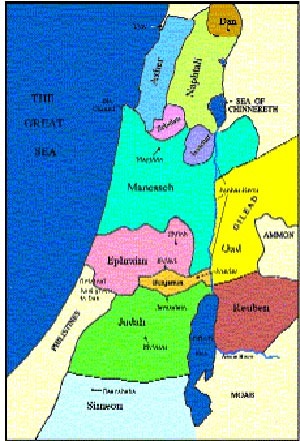
Territories for Simeon, Judah, Dan, Benjamin, Reuben, Ephraim, Gad, Manasseh, Issachar, Zebulun, Asher, Naphtali and Manasseh

Palestine was Jewish land.  It was a basic tenet to Christian theology that the loss of the Jews' national independence was an act of G-d.  It was designed to punish the Jewish people for their rejection of "Christ." Christians felt they had to help G-d so that some emperors' minimal criteria of oppression and restriction of the Jews was always maintained as well as the maximum sort, such as in the Spanish Inquisition of 1492.

Eretz Yisrael (Israel and Judea) was the country of the Jews of which even the size and geography is outlined in the Torah/Bible.  That it was his country was a part of his theoretical exercise, an article of his theology and a sophisticated political feeling.  It was a pervasive and inextricable part of his daily life.

Jewish prayers and Jewish literature are filled with the love and longing for and the feeling of belonging to Eretz Yisrael and has been going on for the past 4,000 years.  It's part and parcel of our DNA.  It's in our soul.  "There is no theme so pervasive in the literature of any other nation," no theme that has yielded so much thought and feeling and expression as the relationship of the Jew to his land in Jewish literature and philosophy.  After all, G-d had led Moses back to the land and through Moses directed the people of the Exodus  where they should settle.

Jerusalem was taken and burned in 70 CE by the Romans.  The Jews' attachment to this land has never wavered.  Though many of the Jews were led away then as slaves, there were others, especially in the Galilee, who had never left.  Jewish life was maintained in the country.

In 135 CE, Simon Bar Kochba led a revolt against the Romans which failed. It had been the fiercest and longest revolt ever faced by the Roman Empire.  There were 580,000 Jewish soldiers that died defending their land.  Many civilians died of starvation and pestilence.  985 Jewish villages were destroyed.

 That was over 60 years after the 2nd Temple was destroyed.  The Romans decided to waste the country then in a determined effort to stamp out the Jewish identity.  They plowed over Jerusalem at the direction of Emperor Hadrian.  Then they renamed it Aelia Capitolina, and Judea was renamed Syria Palaestina.

Banished from Jerusalem, Jews went to the Galilee in the northern section of their land.  Refugees returned.  Jews sold into slavery were redeemed and returned.   There arose some of the most important creativity of the Jewish people when the Mishnah and the Jerusalem Talmud were finished.  Most of the people farmed the land.

The Roman Empire became Christian by the 4th century CE.  Their policy was to stop any spark of Judaism that might show up.  Even so, 43 Jewish communities in Palestine in the 6th century were revived:  12 towns on the coast, in the Negev and east of the Jordan,  and 31 villages in Galillee and in the Jordan Valley were reborn.  National restoration was in the hearts of the Jews.  In 351 they staged another revolt which was put down.  In 438 the Empress Eudocia ended the ban on Jews' praying at the Temple site.

This caused the Jews to think that a period of restoration had finally come and they made an alliance with the Persians who invaded Palestine in 614.  Jews fought at their side and overwhelmed the Byzantine garrison in Jerusalem.  They governed the city for the next 3 years.  The Persians made peace with Emperor Heraclius and Christian rule was reestablished.  This meant that Jews were banished from the city again.  The Byzantine persecution started up again but was short-lived because in 632, when Mohammed died, the Moslem Arab invaders came and conquered the land.  By 640, Palestine had become part of the Moslem Empire.

They ruled for 450 years, first under the Omayyads (mostly all Arabs) who governed tolerantly from Damascus, and then under the Abbasid dynasty (mostly all Turkish) who governed from Baghdad.  So Jews were governed either tolerantly or persecuted and then ruled by the Fatimids from Cairo.  The Moslem Arabs took away lands from the Jews that they had held onto for 20 generations after the fall of the Jewish state.  The Crusaders came after them and had ruled Palestine or parts of it for a little more than 2 centuries and it was they who massacred the Jews in the cities.  Under the Moslems and Crusaders, the Jewish communities of Palestine held on with their prayers and chutzpah and survived.  The Jews had been some of the best fighters against the Crusaders.  When the city of Jerusalem fell, the Crusaders had gathered the Jews up in a synagogue and burned them.  Haifa was defended by the Jews for a month from June to July 1099.  In that year, 1,000 years after the 70 CE fall of Jerusalem, there were Jewish communities that had sprung up all over Ha'aretz (Palestine).  50 of them remain well known, such as Jerusalem, Tiberias, Ramleh, Ashkelon, Caesarea and Gaza.

In 1516 the Ottoman Turks were tolerant and fairly  friendly towards the Jews.  30 Jewish communities were recorded then:  Haifa, Sh'chem, Hebron, Ramleh, Jaffa, Gaza, Jerusalem and many in the north.  Their center was Safed (Tzfat) which became the largest in Palestine and took on the spiritual leadership of the whole Jewish world.  The mystic Caballa was developed.  8,000 to 10,000 Jews lived here in 1555 and the population grew to 20,000 or 30,000 by 1600.  Some of the Galilean villages survived, showing that Jews clung to the land for 15 centuries in succession.  Jews brought in the first printing press into Palestine, and Asia, for that matter.  It was brought to Safed and printed in Hebrew.  Maybe it was their prosperity that caused Sultan Murad III in 1576-77 to deport 1,000 wealthy Jews from Safed to Cyprus, where he needed some economic assistance.

                                          Chronology of Jews in Ha'aretz

1250 BCE    Moses' appointed leader, Joshua, led the 600,000 Israelites into the Land of Israel
1000-922 BCE  King David and son Solomon ruled a united Jewish kingdom in Israel
721 BCE           10 of 12 tribes of Jacob  are defeated by Assyrians and taken into exile, slavery
586 BCE           Babylonians defeat kingdom of Judah and exiled leaders, people to Babylon
539 BCE          Cyrus the Great of Persia sends Jews back to Israel, live and rebuild temple
458 BCE          Ezra leads exiled Jews back to Israel
332 BCE          Alexander the Great conquers Israel
167 BCE          Jewish Maccabees revolt against Greek  Antiochus IV Epiphanes
37-4 BCE        Herod, appointed by Rome, ruled over Judea, works on Temple
70 CE              Titus, emperor of Rome, crushes Jewish revolt
135                  Bar Kokhba Revolt
1096          First Christian Crusade massacre Jews across France, Rhineland, Bohemia on way to Jerusalem
1146                Second Christian Crusade, Jewish communities attacked
1453               Ottomans conquer Constantinople, invite Jews to return to the city
1880-1897      Theodor Herzl holds 1st Zionist Congress for return to Eretz Yisrael, Jews have returned
1904-1914      2nd Aliyah, 40,000 Jews from Russia return to Ha'Aretz, 3rd and 4th aliyote followed
Nov 2, 1917   Balfour Declaration of Jewish National Homeland Declared
May 14, 1948  State of Israel Declared; 600,000 Jews in Population
2013               Israel population :  6 million Jews, 1.7 million Arabs

There is no other people in the world who have maintained their love for their original land as much nor as long as the Jews have, nor has there been a people from the ancient days that have existed for so long as this people maintaining their religion.  Though Judaism has grown along with the generations, the main concept has remained the same.  It is not an "old time" religion but one that is prevalent in today's age along with its people who are  among the most creative and intelligent. Judaism is based on social righteousness.   Jews in Israel continue to cling to their beloved Ha'Aretz; the tiny speck of land of Israel;   the granted 20% of what used to be theirs.

Jews were chosen by G-d to carry out a heavy duty, and only G-d knows how hard they have tried to do this.  They were chosen not because they were the best of all people but because they had such a stubborn trait, a stiff-necked people.  They had been chosen to carry the message of G-d's law to the world, based on the covenant between G-d and Abraham and renewed at Sinai with Moses.  Isaiah described Israel as  those whose sufferings will bring salvation to the world.  One thing we know.  Jews have long suffered in the world.  Israel was said to be a kingdom of Priests and a holy nation.  How many people of the world still scoff at the Golden Rule today?

Resource:  Battleground-fact and fantasy in Palestine by Samuel Katz
Jews and Power by Ruth R. Wisse
The Source by Leon Uris

Saturday, May 11, 2013

The Scattering of Jews Throughout the World: Where Did They Go After 70 CE?

Nadene Goldfoot                                                                       

                  The Arch of Titus in Rome Depicting the Jewish Slaves Taken from Jerusalem
                                                               
The last king of Israel was Hoshea (730-721 BCE).    Assyria in western Asia  had attacked Israel and taken away many of the people as slaves in 732 BCE.  Jerusalem had become a vassal of the Neo-Assyrian Empire.   Judah had divided from Israel and was the southern section of Israel. The last king of theirs was Zedekiah (597-586 BCE).  From 587-6 BCE The Babylonians, also of western Asia, the land of Shinar or of the Kasdim (Chaldees),  of Ur, (Iraq), were from the Chaldees, an ancient Babylonian city.  It was Abraham's place of birth.  The Babylonians  had conquered Jerusalem.  Nebuchadnezzar II fought Pharoah Apries's attempt to invade Judah.  Jerusalem was mostly destroyed including the 1st Temple and the city's prominent citizens were deported to Babylon.

Cyrus the Great came along in 539 BCE and conquered Babylon.  He allowed the Babylonian Jews who had been there for almost 50 years to return from captivity to Jerusalem and rebuild the Temple.  That was about 2 generations that had lived in Babylon.

Artaxerxes III tried to retake the city and Jerusalem revolted against him in 350 BCE.  The city burned down in the melee.  Jews who supported the revolt were sent to Hyrcania on the Caspian Sea.

Jerusalem capitulated from 332-200 BCE  to Alexander the Great and is later incorporated into the Ptolemaic Kingdom in 301 BCE and then the Seleucid Empire of 200 BCE.  Things got worse for Jews.  By 175 BCE Antiochus IV Epiphanes, a Seleucid,  tried to eradicate the Jewish religion by outlawing Sabbath and circumcision.  He sacked Jerusalem and erected an altar to Zeus in the 2nd Temple after plundering it.  In 164 BCE the Hasmoneans take control of part of Jerusalem while the Seleucids had control of the fortress (Acra) in the city and most of the surrounding areas.  By 63 BCE the Roman Empire under Pompey took Jerusalem.

Before 70 CE Jews were living in France.  Communities existed there during the Roman Empire period.  Christianity came along and established anti-Jewish laws.  By 1306 they were thrown out.  In 1420 the Jewish community in Toulouse, France was annihilated.

General Titus 70 CE, a Roman, ended the major part of the Great Jewish Revolt that had begun in 66 CE and destroyed  the 2nd Jewish Temple. that he referred to as "Herod's Temple."   Many Jews were killed.  Those residents of Jerusalem who survived the attack were scattered through Rome's Empire by the Romans themselves.  This victory was called early as the fighting went on for 3 more years.  Vespasian had commanded the Roman campaign against the Jews until the death of Nero in 68.  Vespasian then passed his command to his son, Titus and returned to Rome.  There he was declared the new Emperor in 69.

A parade took place in Rome.  Besides all the booty that the Romans seized out of Jerusalem which was gold and silver, yards and yards of fine material were the Jewish slaves.  They walked not as a mob but an orderly line of prisoners worth seeing clothed in a variety and beauty of clothing that diverted the eyes of the Romans from their injuries incurred in battle.  The sacking of Jerusalem is depicted on the Arch of Titus in Rome today.  Romans viewed the objects taken from the holy Temple:  a golden table, a 7 golden lamp stands with branches or arms extended emphasizing the honor paid by the Jews to the number seven.  The tablet of the Jewish Law was carried last, then ivory and gold  objects.  Vespasian and Titus rode on horseback at the end.  This was a holiday celebrating their victory against the Jews. Jews have lived in Italy since the 2nd century BCE in Rome and then in the southern ports and along trade routes in at least 40 places. In the 1200's in Naples persecution in Naples forced some Jews to convert.    In 1541 the Jews of of kingdom of Naples were kicked out.  

From 132 - 135 CE the last stand against the Romans was fought by the Jewish Bar Kochba who lost the fight with the very brutal Romans.  Hundreds of thousands of Jews were killed or exiled.   Hadrian formally re-established Jerusalem in 136 as Aelia Capitolina and the land as Palaestina.   He forbade the Jewish and Christian presence in the city, but Jews lived in other parts of what was Israel and Judea.  Two years later the restrictions were relaxed for Christians but not for Jews.  From Italy many Jews wound up in Middle East lands until 1948.  Others headed for Germany and on up from there into Eastern Europe.

The Roman Empire dates from 27 BCE, when Octavian became Emperor, Augustus.  Kings ruled it first, then the Roman Republic, and then by an emperor.  The slaves brought to Rome could have been sold and transported to other parts of the Roman Empire which would be in today's lands of Britain  but not yet Scotland,  Spain, Portugal, France, Italy, Greece, Turkey, Germany, Egypt and the north coast of Africa.  The Romans in charge spoke Latin.  By 1355 there were 12,000 Jews who were massacred by a mob in Toledo, Spain.

Trade was most important for Rome, a city of more than a million people, the largest in the world at that time.  Possibly Jews got involved in this.  They needed wheat from Egypt, tin from Britannia, mainly from the peninsula of Cornwall, grapes from Gaul, etc.  In return, the Romans built capitals into fine cities, protected people from raids by barbarians and provided education and career opportunities for the young adults in the provinces such as careers in the Roman army.  They had a staff of civil servants.

Their political power shifted to Constantinople and the Catholic Church replaced Rome's authority.  Germanic tribes living along the northern borders of the empire and were mercenaries in the Roman army emerged as powerful forces in their own.  The Visigoths were one of many German tribes.  Rome experienced an invasion of the Visigoths.

Hungary became home to Jews from the 100's as a Jewish grave was found dating back to the 2nd century.  .  Jewish communities were known about in the 800's.  From 1349 till 1360 Jews were thrown out of Hungary.

In 321 there were Jews living in Cologne, Germany.  They settled in other places then along the Rhineland.  Jewish soldiers were in the Roman garrisons in Germany as well.  by the 8th and 9th centuries the Carolingian royal house was pro-Jewish and encouraged the settlement of Jews because they wanted to develop trading.  Romania was also home to Jews since the 300's.  They were among the 1st settlers of the city of Roman in 1391.  In 1421 Jews were kicked out of Austria.  Jews had come to Austria with the Romans, but for sure in  906.  It was the persecutions going on in Germany that forced them to move to Austria.  The Holocaust, murdering 6 million Jews started in Germany with the Nazi regime from 1939 to 1945, but offenses started much earlier in the 1930's.

By 324-325 the Emperor Constantine held the 1st council of Nicaea and made Jerusalem a Christian patriarchate.  Waves of Christian immigration to the city began.  Jews were finally allowed to enter once a year to pray at the Western Wall on Tisha b'Av.  The first monastery in Jerusalem on the Mount of Lives was built in 380.

Jews lived in Poland from the 800's on.  It is thought that settlers came from either Germany, Bohemia or Kiev in Russia or the Byzantine Empire.  The thought is that they were reinforced by KHAZAR elements.  Khazaria was an empire in southern Russia created in the 700's.  The Kagan converted to Judaism and it was a haven for Jews suffering from discrimination in other states.  Early settlers in Poland were thought to be traders.  In the Dark Ages they helped to open up the area to civilizing influences.  The first Jewish charter was in 905.  Then the Tartars of Russia invaded Poland in 1240. To restore the economy, the kings encouraged immigration of merchants from Germany.  They brought with them their language of Yiddish which is a combination of Hebrew and German, rituals and passionate devotion to Talmud study.  1648-1656 was the scene of 100,000 Jews murdered in Poland in the Chmielnicki massacre.

Also in the 800's were Jews that immigrated to the Ukraine in waves from KHAZARIA, the Caliphate and Byzantium until the 1100's.  Jews immigrated there from Central Europe from the 1300's to the 1400's.   and from Poland from the 1500's to 1600's.  Massacres of Jews then took place. to the 1700's.  Hasidic movements sprang up in the 1700's.  Zionism took place here from 1800 to 1900's.  People moved in here from Galicia and White Russia.  It was always a center of anti-Semitism and the scene of many pogroms.from 1905 to 1918.

In 1099 the 1st Crusaders captured Jerusalem from Muslims and slaughtered most of the city's Muslim and Jewish inhabitants.  The Dome of the Rock was converted into a church.  In 1267 Nachmanides went to Jerusalem and prayed at the Western Wall and reported that he found only 2 Jewish families in the city.  As they weren't allowed to really live there, Jews found other places nearby that weren't on the radar of tourists.

Again, Hungarian Jews had a segregation of Jews from others in the 1200's and they had to wear a badge.  Jews living in England in 1290 were thrown out.

In 1321 Jews were starting to live in Lithuania.  By 1398 Karaites lived around Kovno totaling 10,000. by 1495, after the Spanish Inquisition, to 1502 they were thrown out of the country, in line with Spanish Christianity.  They were allowed back in by 1529 but had to wear the Jewish badge by 1566.  Jews were living in Latvia in Courland from the 1500's.  2,000 lived there in 1795 when it was annexed to Russia.

In 1492 was the Spanish Inquisition in Spain when all Jews either had to convert to Catholicism or leave the country. They left for Portugal.  180,000 Jews left.  50,000 converted and remained.  In 1497 Jews in Sicily, Sardinia and Portugal were kicked out of their countries.  In 1502 all Jews in Rhodes were either converted or taken into slavery.

By 1517 the Ottoman Empire captured Jerusalem under Sultan Selim I, now Caliph of the Islamic world.  In 1700 Judah the Pious and 1,000 followers settled in Jerusalem.  In 1821 the population majority in Jerusalem were the Greek Orthodox Christians.  In 1860 the first Jewish neighborhood was built outside the Old City walls, so from 1873 to 1875 Mea Shearim was built.  The returning Jews came in 1882, known as the 1st Aliyah. They were Russians tired of being in pogroms.   However, by 1901 the Ottomans had restrictions on Jewish immigration and land acquisition in Jerusalem.  1901 to 1914 was the period of the 2nd Aliyah and 40,000 Jewish pioneers entered.

It wasn't until 1812 that Bessarabia, formerly Romanian, part of Moldavian and Ukrainian Republics, were found to have Jews living there.  At this time it was annexed to Russia.  Jews weren't allowed in Russia proper  from 1791 until 1882 as decreed by Catherine II.  That's why they were confined in the Pale of Settlement which constituted Poland, Latvia, Lithuania, Ukraiane and Belorussia.  Bessarabia and White Russia are also included in this.  Jews had been kicked out of Russia by 1727 and again in 1747.  In 1871 to 1921 anti-Jewish pogroms took place in the towns of Russia.   From 1882 to 1890, there were 750,000 Jews living in Russia who were forced to re-settle in the Pale, even though the decree was up. This is when many Jews managed to leave for the USA and Great Britain.  Even in 1891, Jews were expelled form Moscow and St. Petersburg.  

In 614, a Jewish force of about 20,000 aided the Persians (today's Iran) in the conquest of the land of Palestine.  In exchange, the Persians promised some autonomy and the right to return to Jerusalem.  This was ended by the Byzantines coming to power.  In 1838 in Meshed,  Persia, the entire Jewish community was forced to convert to Islam or face death.

WWI from 1914-1917 had the Ottomans on the side of the Axis powers of Germany and they lost.  The British took control and held the mandate.  The Balfour Declaration was issued a month before the end of the war.  The 3rd Aliyah happened from 1919 to 1923 and brought in 35,000 Jewish immigrants to the mandatory Palestine region.  From 1924 to 1928 the 4th Aliyah had 82,000 Jewish immigrants entering Palestine.  From 1929 to 1939, a bad year in Germany for Jews, the 5th Aliyah brought in 250,000 Jewish immigrants.  Many were turned back that were escaping Nazi Germany.  This was already announced to be the National Jewish Home and was cleared by the League of Nations, but Britain had sided with the Arabs by then.

In 1941, when WWII started, the Jewish community in Baghdad was attacked by mobs which killed 180 Jews.
1948-49 amounted to an Arab Israeli War and all Jewish residents of the eastern part of the city were kicked out by the Arab forces and the entire Jewish Quarter was destroyed.

Jews found land to live in-but only temporarily.  They had to be on the move.  Now they're staying put in their own country after 2,000 years of this turmoil only to face fighting for it for dear life.  As for the Land of Israel and Judah, it was never occupied by people who ruled for 1878 years from 70 to 1948.  Foreign governments claimed the land; and that was it.  The name was changed and not much else.

Resource:http://www.eyewitnesstohistory.com/rometriumph.htm
 http://www.metmuseum.org/toah/hd/roem/hd_roem.htm
http://simple.wikipedia.org/wiki/Roman_Empire
http://www.jewishvirtuallibrary.org/jsource/judaica/ejud_0002_0015_0_15340.html
http://www.jewishvirtuallibrary.org/jsource/History/pale.html
facts about Israel from division of information, ministry for foreign affairs, Jerusalem
The New Standard Jewish Encyclopedia

Sunday, February 24, 2013

Jews: What Happened to Them After King Saul of Israel

Nadene Goldfoot
Saul,  of the Tribe of Benjamin,  was chosen  to be the first  king of Israel (about 1020-1004 BCE..  David, from the tribe of Judah,  was the next king and founded a dynasty of  4 hundred years until the Babylonian conquest.  He had created a kingdom and made Jerusalem its capital (abt 1,000 BCE).  Solomon, his son,  (965-928 BCE) caused the kingdom to become an important power in the Middle East.  He built the First Temple (960 BCE).  During his reign Hazor, Megiddo and Gezer were founded.

Solomon died and the kingdom split into two:  Judah with the capital in Jerusalem under King David's descendants and Israel which continued with the original name and its half with a new capital in Samaria, ruled by a series of dynasties. Their first king was Jeroboam, from the tribe of Ephraim (933-912 BCE).

Israel came to an end in 722 BCE when Assyria conquered it and part of the population was exiled.  Sargon II was the conqueror who resettled it with Cutheans (idolaters, possibly of Assyrian people)  who intermingled with the remnants of the Israelites.  They had converted but retained their idol worship and finally Jews were not allowed to marry them.  The capital, Samaria, became a center in the Persian period and became a Macedonian colony in 331 BCE.  It became a village in the Arab period.

The Samaritans are probably the descendants of the remnant of Ephraim or Manasseh tribes and the non-Israelite colonists brought in and live today as a small ethnic group and separate religious sect in Nablus and in Israel. Their religion is a primitive form of Judaism but their bible is only the Pentateuch with variations.  To them, the sanctuary is Mt. Gerizim.

Judah was conquered in 586 BCE by the Babylonians who destroyed the First Temple.  A large part of the population was exiled to Babylon (Iraq today) and others fled to Egypt.  Large Jewish communities had existed since that time in both Israel and Judah until before 1917 when they dwindled.
The prophets existed during this 500 year period.  Their message basically was the struggle for social justice.
_______________________________________________________________________________
The Babylonian Empire was finally overthrown by the Persians (Iran) so the land of Israel was also under Persian rule.  King Cyrus of Persia allowed the Jews to return to the Land and rebuild the Temple (538 BCE).  Jews then lived in their land autonomously for 400 years under the Persians.

After 332 BCE Jews were under Hellanistic rule.  In 168 BCE the Hellenistic ruler of Syria, Antiochus Epiphanes IV tried to limit Jewish autonomy and replace monotheistic belief with idolatry.  The Jews revolted under the leadership of a Hasmonaean family and regained their independence.  It's thought that the Hasmonaeans were of the tribe of Levi.  They ruled Judah.  Herodian then ruled after that.

By 63 BCE the kingdom was part of the Roman Empire.  Herod  ruled and he was responsible for the reconstruction of the Temple. Herod was the son of Antipater the Idumean  and his wife, a Nabatean named Cypros.  He had been appointed by his father to be the governor of Galilee.  He was appointed king of Judea by the Roman senate and had captured Jerusalem in 37 CE with the help of the Romans.  Idumean or Edom was a country in SE Eretz Israel, also called Mount Seir.  It lay south of the Dead Sea and bordered the Red Sea at Elat.  The people were of Semitic origin, descendants of Esau and lived by  hunting.  They were traditional enemies of Israelites.  They fought Saul but were defeated by David.  They were conquered by John Hyreanus who forcibly converted them to Judaism, and then they became a part of the Jewish people.  Herod was one of their descendants.  John Hyreanus was the son of Simon the Hasmonean (135-104 BCE)  who beat Ptolemy in taking Jerusalem.

Jerusalem became an important metropolis with about 200,000 people.  Herod died in 4 BCE.  Romans tightened their rule.  In 66 CE Jews revolted against the Romans until 70 CE when the Romans destroyed Jerusalem and the 2nd Temple.  In 73 CE, Masada, the last Jewish fortress was taken by the Romans.   At this time the Jewish population was about 3 million.

Bar Kokhba was a leader who revolted against the Roman Empire and died in 135 CE in the revolt against Hadrian.  He was a descendant of King David.  Letters written by him were discovered near the Dead Sea.  The Romans had been rebuilding Jerusalem as a Roman colony and they were prohibiting circumcision.  There were 580,000 Jewish casualties in this revolt.  Many others died of hunger and disease.  Judah fell into desolation.  Jerusalem was then barred to Jews.  The revolt lasted over 3 years involving the best of the Roman forces.

Then many Jews were driven into exile and large Jewish communities emerged in other Middle East countries and beyond. They wandered as far as Saudi Arabia where whole Jewish tribes were forced to convert to Islam or be killed.  Jewish communities were founded all over the Middle East.and came to be known as the Sephardi Jews as contrasted by the Ashkenazi Jews who wandered farther into Europe.

 Jews had originally entered the land of Canaan with Moses (1391-1271 BCE) and consisted of the children of the 12 sons of Jacob, his 2 wives who were sisters (Leah and Rachel) and their 2 handmaids (Zilpah and Bilhah)  who had founded their own tribes.  Reuben, Simeon, Levi, Judah, Issachar, Zebulun, Joseph, Benjamin, Gad, Asher, Dan and Naphtali.  Judah was always the largest of the tribes.  Jews think of themselves as being either Cohens, Levites or Israelites.  Today with the development of DNA studies, the Cohen gene (haplogroup J1)  has been found. The interesting factor is that most of these people are also functioning as the Cohen in their synagogue, showing why this is called the Cohen gene.  This is an inherited position in the synagogue that comes with certain responsibilities, namely being called as the first reader from the Torah on Saturday (Shabbat).  It shows that oral history has passed down correctly for 2,000 years.  Another J1 line is the J1c3d which is is thought to come from Arabs and originating from Esau, Isaac's half brother.  This branch does not reflect many Jews but is a Semitic line.

We must remember that Abraham and his father, Terah, left Ur (Iraq) to establish a monotheistic religion. If Abraham and his father were J1....they left ancestors and relatives in Ur who also went on to establish more individuals who would have spread J1...  Abraham, Isaac and Jacob were the 3 who would have continued the Jewish or Cohen J1  Y haplogroup.  Branches of families have been found, such as the Cohen J1c, J2a1b, J2a4 and the other Semitic J1 such as J1c3d who today are Muslims. Also, Jews have been scattered all over the earth, especially in the Middle East.  No wonder we are finding similar Ydna among Jewish and non-Jews.

Resource:  http://en.wikipedia.org/wiki/Tribe_of_Benjamin.
Facts About Israel from division of information ministry for foreign affairs, Jerusalem
The New Standard Jewish Encyclopedia
http://en.wikipedia.org/wiki/Jeroboam
http://www.myjewishlearning.com/texts/Bible/Origins_of_the_Bible/Other_Ancient_Texts/Books_of_Maccabees/First_Maccabees.shtml
http://www.schechter.edu/AskTheRabbi.aspx?ID=477 Cutheans
http://en.wikipedia.org/wiki/User:Victar/Haplogroup_J1c3d_(Y-DNA)
http://en.wikipedia.org/wiki/Talk%3AHaplogroup_J1c3d_(Y-DNA)
http://kahana.hubpages.com/hub/More-on-the-Kohanim-DNA-Question


Thursday, April 5, 2012

Bar Kochba's Jewish Rebellion Against the Romans and the Aftermath in Arabia and Islam

Nadene Goldfoot
The Temple of the Jewish people in Jerusalem was destroyed in 70 CE, and Jerusalem was under the rule of Hadrian who attempted to prevent circumcision in 130 CE with his beginnings to hellenize the city.    A leader arose by the name of Bar Kochba who had 200,000 men to command.  They recaptured Jerusalem and also many other towns and villages throughout the land.  A war raged for about 4 years against the Romans.  The enemy had to bring in legion after legion of reinforcements to suppress the Jews.  Israel had become a nation about 1220 BCE and wasn't about to lose their land so easily. 

Ultimately, the Romans sacked the city of Jeruslaem abt 132-135 CE  with an army of 35,000  whose commander was Julius Severus who was under Hadrian  and expelled a good many of the survivors. They destroyed 50 fortresses and 985 villages.   About 580,000 Jewish men were killed besides those that died of hunger and disease.  The Roman Emporer Hadrian changed the name of the city to Aelia Capitolina.  Then he ordered the building of a temple to Jupiter on the Jewish temple site and  excommunicated all Jews from the city and if found would be killed.  Judea then was called Syria-Palaestina.  Not only did Jerusalem become a pagan city, but Hadrian had a statue of himself placed on the site of the Holy of Holies. 

Jews may have stayed away from Jerusalem at that point, but not the rest of the land.  Others returned.  Some Jews left the land to go to places like Arabia where they formed new settlements or joined other Jewish Arabian communities that had been established around the time of their captivity in Babylon or even before then. 

Jews had probably settled in Arabia at the fall of Samaria in 721 BCE.  There was even a Jewish military colony in Aswan and upper Egypt founded just after the fall of Samaria.  In the 1st and 2nd centuries CE Arabia offered a near asylum to Jews victimized by the ruthless Romans.  By the 7th Century CE it would spawn Islam, but a number of Jewish and Christian settlements were established in different parts spreading Aramaic and Hellenistic culture.  A Christian center was Najran.  Jews and Judaised Arabs were everywhere, especially in Yathrib, later named Medina.  This was to become the Arab world's 2nd holiest city, first settled by the Jewish tribes from the north, the Banu Nadir and Banu Quraiza.  It's where Mohammad listened to Jewish stories from the Torah from readers on the streets. 

Resource: From Time Immemorial by Joan Peters pages 140-141

The Standard Jewish Encyclopedia

Thursday, December 8, 2011

Logic Has No Hold in the Middle East : Anti-Semitism Practiced by Semite- Arabs

Nadene Goldfoot
Right now there are 48 Muslim majority countries in the world with over 1 billion people living in an area 672 times the size of Israel.  These same Muslims are having a fit over the creation of the only Jewish state in the world that happens to be in their neighborhood.  They are more than intolerant-they are anti-semitic!

1.4 million Arabs are citizens of Israel, but the planned Palestine will have no Jews at all.  Arabs in Israel have the same citizenship as Jews do, even their own political parties and are voted into the knesset.  Yet Jews are not allowed in Arab countries today.  The recent earthquake in Iran called for all people to come help them except the Jews. 

Over 3,300 years ago Israel was the birthplace of the Jewish people.  This biblical kingdom was first ruled by Saul in 1020 BCE.  King David ruled from 1004-965BCE and his son, King Solomon ruled from 965-930 BCE.  When Solomon died the kingdom was split into the northern kingdom of Israel and the southern kingdom of Judah.  Then the Romans conquered the area in 70 CE and it was renamed as Palestine in 135 CE to eradicate the Jewish presence.  To the Jews who never left, it has always been known as Eretz Israel.  Though much of the land was decimated and prisoners were taken or killed, some did remain.  We have always managed to have a Jewish presence in the land.

The first Arabs arrived as conquerors in the 7th century, 2,500 years after the Jews had been there.  Jewish tribes were living in Saudi Arabia but were either killed or converted by Muhammed and his followers when Islam stormed the area.

Jews started returning to Eretz Israel in the late 1800's and created the kibbutz. They bought land legitimately, drained swamps, killed mosquitoes and started communities. They  had been caught in pogroms in Russia and had endured anti-semitism in Europe.  They felt they needed their own homeland and remembered Jerusalem in their prayers every day for 2,000 years.  This caused them to form zionist congresses and confer with Arab leaders.  They bought land from Arab landowners who were living in Europe, and paid the extreme high prices because the unkept, deserted, swampy barren land was precious only to them because of their history with it. After all, it was G-d who told them to live there.  We are eternally tied to this land. 

In 1917 after WWI, Britain was given the task of supervising Palestine.  Jews had fought with the British and Arabs had fought with the Germans.  Chaim Weisman, Jewish,  developed dynamite for the British and Jews were rewarded the homeland they had strived for.  Our promised homeland consisted of both present day Jordan, Israel, and the administered territories.  This was all written up in the Balfour Declaration.

Yet the British also made promises to the Arabs, so in 1922, Britain transferred 2/3 of the mandated Palestine to the Hashemite Bedouins who were driven out of Saudi Arabia by a rival clan.  That became Jordan and no Jews were allowed to live inside it, even today.  Yet Israel allowed Jordanians to come across the bridge to work in Israel.  Jordan and the Palestinian Arabs had a war, and somewhere along the way the king married a Palestinian lady.  Now it is made up mostly of Arabs who called themselves Palestinians.  They have stated that they do not want any more Palestinians living in Jordan! 

The Holocaust in Europe took the lives of 6 million Jews.  Those that lived tried to get to Palestine, but the British fought against that, causing many to return to gas chambers or die in the ocean.  Some managed to get into the holy land.  They hit the ground off of ships only to be given a gun to fight Arabs who were attacking Jews.  Was there no place that Jews could find refuge? 

The Arabs that are citizens in Israel today are the ones whose ancestors, about 160,000 of them,  stayed instead of leaving when all the Arab countries attacked Israel.  200,000 had fled upon the warnings of their leaders.  Many successful Palestinian Arabs are the Christians who live in Haifa.   Arab incomes in Israel are higher than others in the rest of the Arab world.  They have freedoms that others can't even begin to understand. 

Ironically, 700,000 Jews had been living in Arab countries, but when Israel was created, they were forced out.  Yemen is a good example.  They came to Israel and were found homes.  Ofra Haza, our famous singer, was from this group of Yemenites.  So just about the same number of Arabs left to become displaced people from then till now living in camps run by the U.N, while the same number of Jews were forced out of their homes by Arabs and were able to be integrated into a European-Ashkenazi community.  Jews living in Arab lands were treated as 2nd class citizens, but they weren't subjected to acts like pogroms.

 Russia was the vilest of all the European countries in keeping Jews on the Pale of Settlement, an area where they were allowed to live.  They couldn't come into Russia proper.  They were kept poor in shtetles for the most part.  France was showing lots of anti-semitic qualities with the Dryfuss affair where a French soldier was treated differently because he was Jewish.  England had periods of keeping all Jews out of the country. 

Despite all the hardships, Jews kept their faith, and Judaism did not die.  Being the first monotheistic faith, that is quite a feat to continue for almost 4,000 years. 


Sunday, October 2, 2011

How Israel Came From Judea and Israel

Nadene Goldfoot
Los Angeles County, California has a population of 9,818,605 as of the 2010 census.  Israel now has a population of 7,797,400, including all of Jerusalem.  Therefore, Los Angeles County is bigger by 2,021,205 people, which is about the population of Houston, Texas.   Of that number, 5,874,300 in Israel are Jewish with 20.5% of the population being Arabs with 1,600,100 people. 

70CE saw the fall of Jerusalem to the Romans.  In 132CE the Jews had a leader, Bar Kochba, who revolted, and when he lost the fight  against the Romans, many of his people fled or had been forcibly taken away into slavery. At this time the population numbered 3 million according to Dio Cassius' writings. In 1785 Constantine Francois Volney described the ruined and desolate country. Alexander Keith wrote 60 years later that the land had not fully reached its last degree of desolation and depopulation. 

This land of Palestine was not a country.  It was merely a name for part of the Ottoman Empire that was originally called Judea, Israel, and Samaria given in 135 by the Roman Emporer Hadrian as Palaestina  to de-Judeaize the land.  They had even changed the name of Jerusalem to Aelia Capitolina.  "To claim that Palestinians are the original people of Eretz Yisrael (the Land of Israel) is not only against secular history but also against Islamic history! "

Jews living in the land were poor and remained mostly in Jerusalem. Joining them were about 500 Jews from Lithuania under the Vilna Gaon in 1808 and again with Menachem Mendel of Shklov, Lithuania in 1809. They settled in Safed, Tiberias and Jerusalem and formed the basis of the Ashkenazi Jewish communities.

In 1835 Alphonse de Lamartine wrote of not seeing any living object outside the gates of Jerusalem and that it was all like a tomb. Mark Twain in 1867 wrote a travel-guide calling it a desolate country with the ground full of weeds, desolation and never seeing a human being on the whole route. He hardly saw a tree or shrub anywhere, even olive and cactus were but few in number. "Palestine sits in sackcloth and ashes." "Palestine is desolate and unlovely"... Evidently the Jews from Lithuania, divided in three different areas were not noticed.

In 1847 a Jewish visitor made a pilgrimage to Palestine and reported the sorry situation and that his fellow Jews seemed conditioned to their plight because they had no protection and were at the mercy of policemen and the pashas who treated them as they wished.  They paid many taxes every now and then.  They had property but it was not at their disposal and they couldn't complain about any injury for fear of the Arabs' revenge.  Their lives were at stake and subject to  daily danger of death.  March 1949 did record a complaint from a Jew of being assaulted and stabbed by a soldier while his house was searched and his females beaten.  This all was able to happen because the land was in the hands of the Ottoman Empire. 

Then, the 1st Aliyah of Jews from Russia came later in 1881-1882 and continued in successive aliyote till 1903, which meant the arrival of between 25,000 to 35,000 more Jews. These are the ones who attracted Arabs looking for jobs.

2,000 years of wandering in other lands after losing theirs resulted in being subjected to pogroms in Russia and being kept on the Pale of Settlement of Russia while not being allowed into other parts of it and anti-semitism in them all.  Jews living in Arab countries were considered as dhminnis, or 2-3rd class citizens.  Finally in 1948 Israel was declared a state through the U.N. In 1948 there were 806,000 residents in Israel. Fighting occured before and after the announcement. 

All this time of 63 years hence Israel has been attacked by the Arabs.  Israel is always having to fight a defensive war to protect what little land they have.  All this time the Arabs have been offered land for peace to create a Palestine  but the offer has been snubbed. 

With Netanyahu again at the helm in the Knesset, Jews show that they are onto the motives and actions of their cousins, the Arabs. Not only is there an Arab Spring, but perhaps there is also a Jewish Spring as well in that the Arabs have hardened the hearts of Israel who understand their motives quite well, finally. The Arabs are also not finding favor in the eyes of the Israelis by their actions. This business of desiring peace, which Israel favors, is not reciprocated by their neighbors. We have to wait. It just may take the Messiach to bring it about.  There is no purpose in negotiating if the prize does not deliver a proper peace. 

Resource: http://www.jewishvirtuallibrary.org/jsource/Society_&_Culture/newpop.html
http://www.levitt.com/essays/palestine.html
http://www.infoplease.com/ipa/A0763098.html
http://answers.yahoo.com/question/index?qid=20090627213016AAGA9bW
From Time Immemorial-the Origins of the Arab-Jewish Conflict Over Palestine by Joan Peters