Nadene Goldfoot
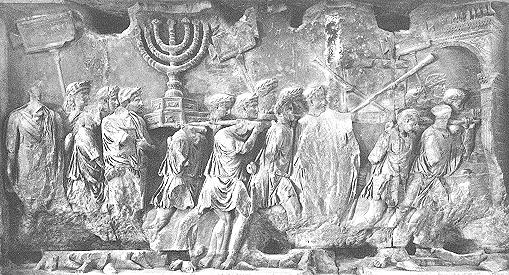
King Solomon's Temple
Moses (1391-1271 BCE) didn't just bring down 10 Commandments. Throughout the 40 years of wandering during the Exodus, started when he was 80 years old already, he wrote 613 more laws for the future Jews to follow till he died at age 120. What do we Jews believe, anyway? The ideas we have of course came from Moses, but they were also interpreted by the Pharisees and the Sadducees.
Two traumatic events happened to the Jewish people. The Assyrians attacked and carried away people in 721 BCE. The Babylonians attacked twice; in 597 and 586 BCE. They also carried away people.
They destroyed Solomon's Temple.
The Jews rebuilt the Temple. During the 2nd Temple period from 538 to 515 BCE, there appeared a political party as well as a religious one, the
Pharisees (the lenient ones)
, who were probably a continuation of the Hasideans,
a pious Jewish religous sect. It was first recorded during the persecutions of Antiochus Epiphanes in the 2nd century BCE when its member suffered martyrdom rather than desecrate the Sabbath and formed the backbone of the Hasmonean revolt. . They were a fairly narrow body and kept a closed membership to the masses. Their job was to teach the traditions to everyone with stories to develop a holy spirit in them. They felt there was a huge gap of knowledge between the masses regarding their own law and themselves and therefore the masses were not practicing it.
They sat apart from the masses in order to keep themselves pure. In other words, they were scrupulous about keeping kosher. They would eat with their own groups and ate only consecrated food in the Temple, or kosher food that had been prepared in the Temple kitchen.
The Pharisees put the people of Judah's life within a
halakhic framework found in the Oral Law which they regarded as vital as the Written Law (the Tanakh). The oral law was the interpretations and analysis of the written law and was handed down orally from generation to generation. It's said it also was given to Moses with the written law. Their doctrine was to embrace the whole life of the community, touching on the theological foundations of life, questions of fate, good and evil, the immortality of the soul, and eschatology.
They admitted Divine predestination but also man's responsibility for his deeds. They believed in life after death, the resurrection of the dead, the Messiah that they needed and the Day of Judgment.
Not all Pharisees were angels in their behavior, of course. The Talmud lists 7 hypocritical types. However,
they "were in reality not like the derogatory New Testament picture" that paints them as terrible people. It just so happens that "they were responsible for strengthening morality and introducing the elasticity which enabled Judaism to withstand its subsequent tribulations."
The Pharissees had the chutzpa to bring into their culture the cult-folk-customs not mentioned in the Torah, such as the
Water-Drawing Festival (Simchat bet ha Shoevah), which dismayed the Sadducees. This was a festival of water-libation observed at the end of the first day of the Feast of Tabernacles. The Sadducees didn't want it included in their observances because it had no authority in the Pentateuch, but the people nevertheless observed it enthusiastically. The ceremonies are elaborately described in the Mishnah under (Sukkah 5). It fell into abeyance with the destruction of the Temple but has been revived in an altered form in modern Israel. I can understand that any holiday involving water emergence or enjoyment would be loved in the hot land of Judah.The Pharisees have been carried into the stream of historic Judaism.
Bill O'Reilly of Fox News on TV has written a book that carries out the derogatory essence of the New Testament. Yes, the Gospels may be sacred to Christians, but they hold a lot of anti-Semitism towards the Jews. O'Reilly's book is
"Killing Jesus," the act that the Christians have been blaming Jews for during the past 2,000 years. It has only been recently that
Pope Benedict XVI finally forgave us, but that was the pope himself. The masses haven't all agreed with him as yet. The pope also wrote a book, Jesus of Nazareth." "
In 'Jesus of Nazareth' excerpts released in 2011, Benedict uses a biblical and theological analysis to explain why it is not true that the Jewish people as a whole were responsible for Jesus' death. Perhaps he still believed that some Pharisees were still responsible. I'm not sure. We've been suffering for this as a people from the Crusades to the Inquisition in Spain. All Jews have suffered from anti-Semitism and this is what has got the masses going, the death of Jesus. From there they have managed to find all sorts of reasons why they hate Jews. We've become the scapegoats of the world.
Interpretations to the contrary have been used for centuries to justify the persecution of Jews. "
While the Vatican has for five decades taught that Jews weren't collectively responsible, Jewish scholars said recently that the argument laid out by the German-born pontiff, who has had his share of mishaps with Jews, was significant and would help fight anti-Semitism today. Of course O'Reilly's main references must rely on the four Gospels which are loaded with attacking Jews. Jesus had died on the cross, and that was something the Romans had been doing to thousands of Jewish men for any slight indiscretion to their own Roman government. But the Christians forming a group after his death blamed the Pharisees and Sadducees for it to have happened. This happened during Herod's time of ruling, a man who was appointed ruler over the Judeans by the Romans.
It was Pontiius Pilate who ruled in the case of Jesus. He was a procurator, a governor of Judea under the Roman emperors and ruled from 26 to 36 CE. As a procurator, he had full powers to inflict punishment including the death penalty, which meant to be placed on the cross. He executed with the cross Galilean patriots (Jewish men) without a trial and introduced Roman military standards into Jerusalem, used Temple funds for the construction of an aqueduct and maltreated the Samaritans for which he was finally recalled to Rome. Jesus was crucified during his term of office along with thousands of other Jews.
The problem lies with the Gospels referring often to the Sadducees and Pharisees because Jesus was in constant conflict with them. They were the ruling group of Israel in religion. The Christians in the Gospel claim that the two groups conspired to put Jesus to death, as told in (John 11;48-50; where it mentions that many Jews were believing in Jesus, the Romans were going to take their nation, and
Caiaphas, a high priest (18-36 CE) that year said that one man should die for the people and that the whole nation would perish otherwise so he prophesied that Jesus should die for that nation. Joseph Caiaphas was appointed as high priest by the procurator, Valerius Gratus and also served under Pontius Pilate. The New Testament represent him and his father-in-law Annas as being responsible for the prosecution of Jesus and the arrest of the apostles. He was removed by the Syrian governor, Vitellius. Then they (other priests ?) took counsel together to put Jesus to death. After that Jesus didn't walk up to the Jews anymore but went into the countryside near the wilderness into Ephraim with his disciples. Mark in 14:53; and 15:1), also presented anti-Semitic words Other mentions of the Sadducees are found in Act 4:1 and Acts 5:17. The Sadducees are implicated in the death of James by writer Josephus (Acts 12:1-2). He was writing for a Roman audience.
The Catholics teach in their Catechism for the Catholic church that from the beginning of Jesus' public ministry, that certain
Pharisees and partisans of Herod, together with priests and scribes had agreed to destroy Jesus. The reason was that they suspected Jesus of demonic possession and accused him of blasphemy and false prophecy which were
religious crimes which the Law punished with death by stoning. It's because he had expelled demons, forgave sins, healed on the sabbath day and had his own interpretation of the Law concerning purity and had tax collectors and public sinners as friends.
In order to disassociate themselves with Jews, the new Christian leaders who wrote the Gospels did paint an ugly view of the Jews of Jesus's day on purpose, I say. They were starting a new movement and needed followers. They believed strongly that because Jesus had pardoned people for their sins that this was a sign that manifested him to be the Savior God himself (cf.Jn 5:16-18). Jews did not and do not today recognize any man as G-d so saw him only as a man who made himself to be thought of as a G-d possibly since he never came out and said he was G-d as far as they knew. Remember, it was the Romans who had been occupying Judah and they believed in such things as men and women who were half god and half man. That was going on at that time. A culture of belief in half god half man or demigods was rubbing elbows with a strict monotheistic culture and they were an invading group also spreading their belief system just by being there and most likely celebrating their festivals. Achilles, half man an half god born from a nymph; Dionyses, son of Zeus, Jason, son of Jupiter, Hercules, son of Zeus. All were worshipped and were men.
My problem with the accusation against the Pharissees and Sadducees is that the Gospels were written several hundred years after the fact. What is being accused has only gossip to go by. Even in Jewish law there has to be several witnesses. This was an accusation that was political in order to put down Judaism and heighten Christianity. It could have taken place without this false accusation on its own merits if they were worthy. I do not blame the writers of the gospel for what they have laid on us Jews, for in Jesus' supposed words, "They knew not what they had done." I blame the people since then for not having the common sense to stop blaming future generations of Jews for something they think went on so long ago. Of course to them, it is killing their G0d or deicide. One thing I noticed is that the Pharisees are blamed for the deaths by stoning, yet it was actually the Sadducees who were as strict as that, telling me the Gospels didn't know as much about the two political/religious groups as they thought they did. It was the Pharisees who were the lenient ones.
"The debate really comes down to the question: When was the New Testament originally written? And this question leads to another important question: Even if it was written at an early date, how do we know the New Testament that exists today is the same as the original? How do we know the modern translations aren't full of human errors, additional content, or the interpretations of countless human scribes?" "The earliest manuscript of the New Testament was discovered about 50 years ago. P52 is a small papyrus fragment of the Gospel of John (18:31-33 on the front; 18:37-38 on the back), and it has been dated to about 125 AD. So that's at least 100 years after the fact. "The manuscripts dating from 100 to 300 AD are almost entirely papyrus fragments. These fragments are named with a "P" followed by a number. The vast majority of them were found in Egypt in the twentieth century, and are now kept in various museums and libraries throughout the world, including at Dublin, Ann Arbor, Cologny (Switzerland), the Vatican and Vienna." Pieces that they have found considered important were from 300, 350 and 450 CE. John, so profoundly anti-Semitic, also was different from the other renditions in that throughout John’s Gospel, Jesus openly presents himself as the divine Son of God, not hiding his identity as he does in Mark. So people reading this Gospel get the double whammy; Jews killed their G0d.
Right around Easter, some actors usually put on a Passion Play. After seeing this, many people are imbued with hatred for Jews and want to kill or maim someone. Hopefully this book of O'Reilly's will not have the same intention or results.
The Pharisees had been in competition with the
Sadducees. (the strict ones) The Sadducees had absolute control of the Temple. Many feel the Sadducees were incapable of adapting to a changing environment while the Pharisees admitted the principle of evolution in their legal decisions. Remember, this was at least 2,044 years ago and they had decisions to make like that. The Sanhedrin's seats were taken mostly by the Sadducees. They worked at keeping the peace with the Romans, who were the occupiers.
The Sadducees stuck with the letter of the written text. Their name seems to have come from the high priest Zadok whose descendants served in the same office until 162 BCE. Evidently the well connected priests and prominent aristocrats belonged to the Sadducees, who were thus influential in political and economic life. To them the Jewish religion was the Temple cult . They differed from the Pharisees in the nature of their religious outlook and way of life. In their view, people must aspire to well-being in their world without expecting recompense in the world to come. They had no belief in a future world like resurrection, or the immortality of the soul and also rejected the existence of angels and spirits. They were purists. They stuck with the Written Law and allowed no more expansion on that. So did the Essenes. So they behaved severely in cases involving the capital penalty and they interpreted the
Lex Talionis ( eye for an eye punishment) literally instead of in the sense of monetary compensation which was adopted by the Pharisees.
Their beliefs were carried out in the Temple where they had the role of priests and they opposed the Pharisaic innovation like the
Water-Drawing Festival. This might have given a foothold to non-sacerdotal circles. They were the supporters of the Hasmonean kings from the reign of John Hyreanus, but they lost their influence under Salome Alexandra and suffered at the hands of Herod. Their whole power and existence was bound up with the Temple cult, and on the destruction of the Temple in 70 CE they disappeared.
The one thing they all agreed upon was that there was but ONE G-d. At this point in time, all the other points of the religion were being debated. It would take another 1,000 years for a rabbinical scholar to emerge and straighten out our religion for us, for Rashi was born in 1040 in Troyes, France and became so well known for his dissertations. He wrote a commentary on the Bible, the Jewish Tanakh.
Joseph Caro, who wrote the Shulhan Arukh, (Prepared Table) or table of laws in 1564-65, is another man who set the record straight as we observe Judaism today with his codes. He was born in 1488 in Toledo, Spain and died in 1575. The Spanish Inquisition occurred in 1492, so he ultimately found his way to the Holy Land. He lived in Safed, where one can visit his synagogue today. His writing became the authoritative code. This rabbi was interested in Kabbalah. The Pharisees had won out after all. .
References: http://www.amazon.com/Killing-Jesus-Bill-OReilly/dp/0805098542/ref=sr_1_1?s=books&ie=UTF8&qid=1396460615&sr=1-1&keywords=killing+jesus+bill+o%27reilly
http://www.haaretz.com/jewish-world/pope-exonerates-jews-for-death-of-jesus-1.346699
http://dictionary.infoplease.com/lex-talionis
http://en.wikipedia.org/wiki/List_of_demigods
http://greece.mrdonn.org/greekgods/hercules.html
http://jewishbubba.blogspot.com/2014/04/sanhedrin-court-of-ancient-israel.html
http://www.religionfacts.com/christianity/features/new_testament_manuscripts.htm
http://en.wikipedia.org/wiki/Oberammergau_Passion_Play
The New Standard Jewish Encyclopedia
Catechism of the Catholic church online
New Testament "Holy Bible" The World Publishing company, Cleveland and New York, King James Version




.jpg+Solomon's+Temple.jpg)


